


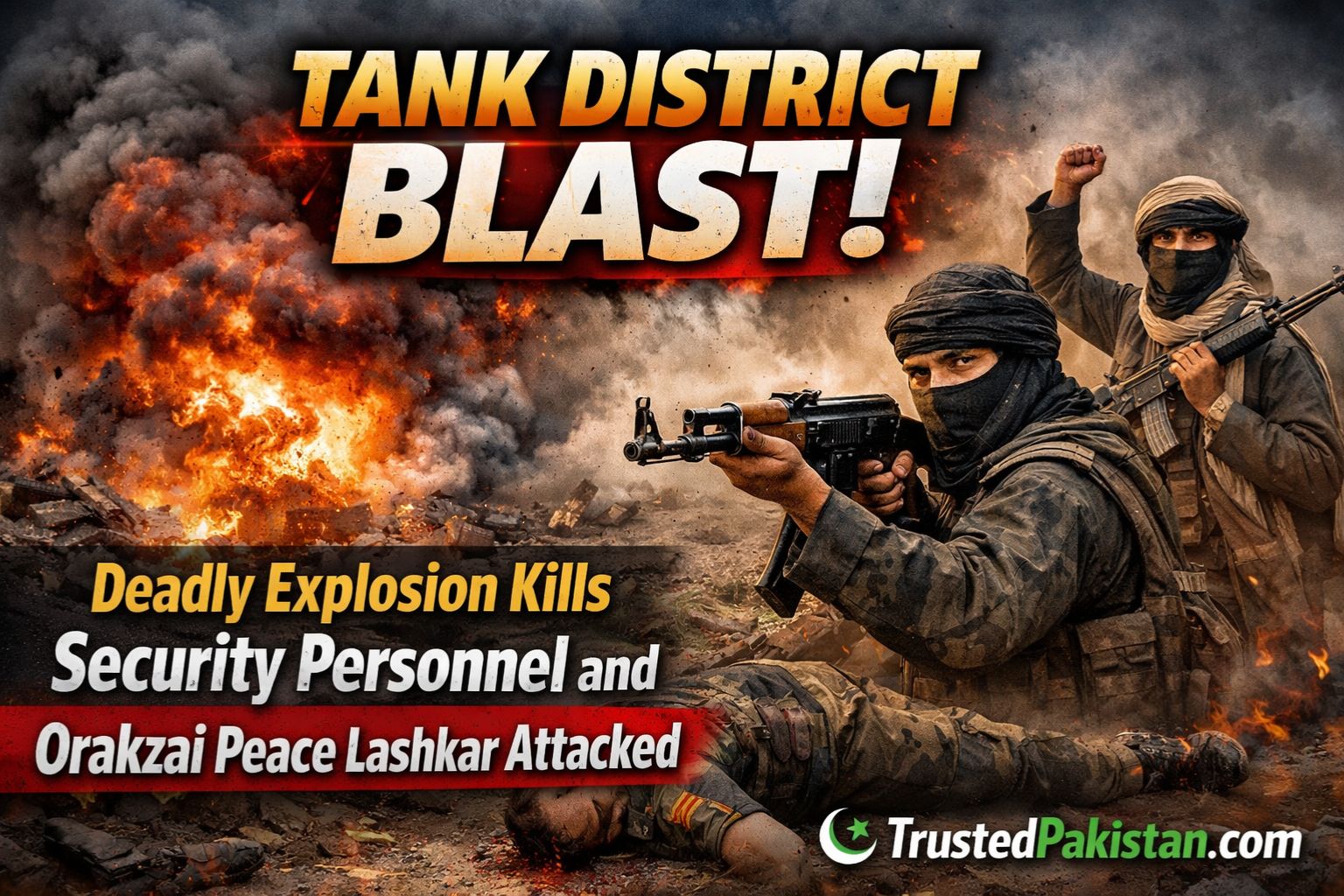
Tank District Blast | Deadly Explosion Kills Security Personnel and Orakzai Peace Lashkar Attacked
The Tank District blast shook Khyber Pakhtunkhwa on January 12, 2026, as a powerful remote‑controlled bomb struck an armoured police vehicle in the Gomal Bazaar area. The explosion tragically claimed the lives of five police officers, including the Additional Station House Officer (SHO), Ishaq Khan. This incident has once again highlighted the persistent threat of militant activity in the region and the dangers faced by security forces on routine patrols.
Rescue teams rushed to the scene after the blast, transferring both the deceased and the injured to the District Headquarters Hospital in Tank. Eyewitnesses reported that the explosion completely destroyed the armoured personnel carrier (APC), leaving a scene of chaos and destruction. Local authorities immediately cordoned off the area while bomb disposal units examined remnants of the device to prevent further incidents.
Tank District Blast and the Rise of IED Attacks
The Tank District blast is part of a troubling trend in which insurgents increasingly rely on improvised explosive devices (IEDs) to target law enforcement. Remote-controlled IEDs have become a preferred tool for militant groups, allowing them to strike with precision and evade immediate retaliation.
Experts say these attacks not only inflict physical damage but also undermine public confidence in the security apparatus. The psychological impact of such targeted assaults can be as damaging as the physical casualties. In response, the local police, Frontier Corps, and federal counter-terrorism units have intensified patrols and intelligence operations in Tank and surrounding districts.
Following the blast, forensic teams meticulously collected evidence to trace the origin of the explosives. Authorities are also reviewing CCTV footage and eyewitness testimonies in their effort to identify the attackers and prevent future attacks.
Orakzai Peace Lashkar Under Attack
While the residents of Tank were grappling with the aftermath of the blast, militants launched another assault in the tribal district of Orakzai. A Peace Lashkar, a locally organised tribal defence group aligned with government security forces, was targeted in the Yakh Kundo area.
The attack left two Peace Lashkar members dead and several others injured. Reports indicate that the local defence unit fought back, killing three militants in retaliation. These community-based groups play a critical role in maintaining stability in previously volatile areas, often serving as the first line of defence against insurgent activities.


The Orakzai attack underscores the ongoing challenges faced by both formal and informal security structures in Pakistan’s tribal regions. Militants continue to test the resilience of these groups, demonstrating the adaptability of insurgent strategies even amid coordinated counter-terrorism operations.
National and Local Response
Interior Minister Mohsin Naqvi condemned the Tank District blast as an act of cowardice. He assured the nation that authorities would leave no stone unturned in bringing the perpetrators to justice. The government also emphasised that the sacrifices of security personnel will strengthen, rather than weaken, Pakistan’s resolve to fight terrorism.
Local communities have expressed deep sorrow and anger over the attacks. Vigils were held in Tank and Orakzai to honour the fallen officers and tribal defenders. Many residents have demanded increased security presence and better protection for those patrolling these high-risk areas.
Why Tank and Orakzai Remain Vulnerable
Tank and Orakzai are strategically significant districts, with rugged terrain and proximity to the Afghanistan border. These regions have historically been hotbeds of insurgent activity, making them highly susceptible to militant attacks.
Despite numerous counter-terrorism operations, militant groups have adapted their methods, shifting from large-scale assaults to targeted IED attacks and ambushes. This shift requires authorities to adopt intelligence-led operations, advanced surveillance, and rapid response mechanisms to prevent future casualties.
Moreover, local populations continue to face hardships due to ongoing insecurity, including displacement, economic instability, and disruptions to daily life. These factors contribute to the vulnerability of the region and the need for continued vigilance from both security forces and local defence groups.
Looking Ahead
The Tank District blast and the Orakzai Peace Lashkar attack serve as stark reminders of the persistent threat of militancy in northwest Pakistan. While security forces continue their operations, the cooperation of local communities, timely intelligence, and robust counter-terrorism strategies remain essential to maintaining peace and stability.
Officials have promised to enhance security measures, improve patrolling, and ensure that future attacks are prevented. For the people of Tank, Orakzai, and surrounding districts, the hope is that sustained vigilance and strategic security initiatives will eventually restore a sense of safety and normalcy to the region.
