


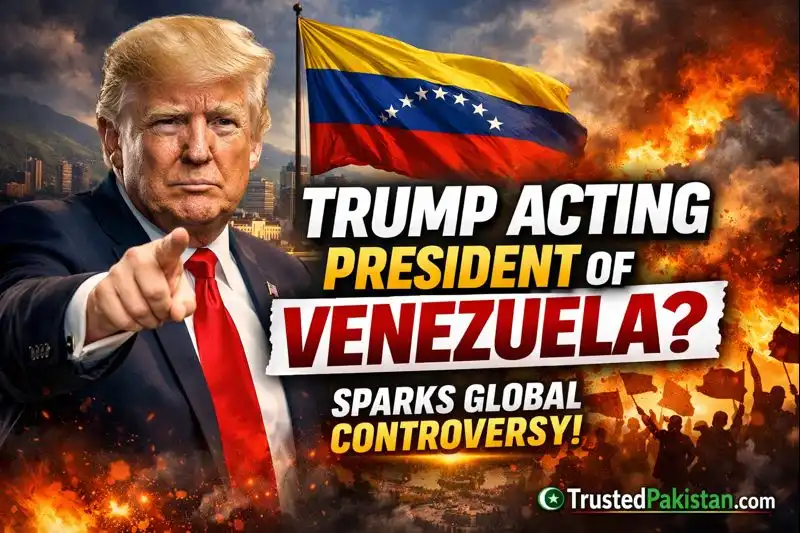
Trump Acting President of Venezuela Sparks Global Controversy
Trump Acting President of Venezuela became a trending political controversy after former US President Donald Trump referred to himself as Venezuela’s “acting president” in a provocative public statement. The remark immediately triggered backlash from Venezuela’s government, international observers, and political analysts, reigniting debates about US involvement in Venezuelan politics and Washington’s long-standing stance against President Nicolás Maduro.
Trump’s statement was widely viewed as symbolic rhetoric rather than an official declaration. However, given his history of strong rhetoric and unconventional diplomacy, the comment quickly gained global attention and raised concerns over political interference and international norms.
Background | Venezuela’s Political Crisis
Venezuela has endured years of political and economic turmoil. The crisis escalated in 2019 when opposition leader Juan Guaidó declared himself interim president, a move recognized by the United States and several Western allies. Although many countries later withdrew their recognition, the episode left lasting diplomatic scars.
Trump’s comment revived memories of that period, when Washington openly backed regime change efforts in Caracas. Analysts say invoking the title of “acting president” again risks inflaming tensions at a time when fragile diplomatic engagement is slowly being restored.
Trump’s Statement and International Reaction
The Trump Acting President of Venezuela claim emerged during a political appearance where Trump criticized socialist governments in Latin America. Though framed sarcastically, Venezuelan officials treated the remark seriously, condemning it as disrespectful and a violation of sovereignty.
Venezuela’s foreign ministry accused Trump of “colonial arrogance” and interference in domestic affairs. Regional leaders in Latin America also expressed concern, warning that such statements undermine stability and diplomacy in the region.
Political analysts argue that Trump’s rhetoric resonates with his voter base but complicates US foreign policy credibility abroad.
US Government Distances Itself
Current US officials quickly clarified that Trump’s comment does not reflect American policy. Washington has recently taken steps toward cautious engagement with Caracas, particularly regarding sanctions relief and energy cooperation.
According to the US Department of State, the United States recognizes diplomatic processes and does not endorse unilateral claims of leadership in Venezuela.
This distancing highlights the contrast between Trump’s personal political messaging and official US foreign policy positions.


Political Impact Inside Venezuela
Within Venezuela, state media portrayed the Trump Acting President of Venezuela claim as evidence of continued US hostility. Government supporters rallied around President Maduro, using Trump’s words to reinforce narratives of foreign aggression.
Opposition figures, meanwhile, distanced themselves from the comment, emphasizing that Venezuela’s future must be determined internally through political dialogue and elections, not foreign rhetoric.
Global Implications of Trump’s Claim
Experts warn that even symbolic claims can have real-world consequences. Trump remains a powerful political figure, and his words influence global perceptions of US intentions.
Diplomatic analysts say such remarks risk:
- Undermining international law
- Fueling anti-US sentiment
- Complicating negotiations on sanctions and trade
- Destabilizing fragile political environments
The controversy also underscores how personal political messaging can ripple across borders in today’s interconnected media landscape.
Media and Public Response
Social media platforms were flooded with reactions ranging from mockery to serious concern. Hashtags related to Trump Acting President of Venezuela trended globally, with users debating whether the statement was satire or provocation.
International media outlets framed the comment as another example of Trump’s confrontational style, while critics argued it distracted from real humanitarian issues facing Venezuelans.
Pakistan’s Perspective and Regional Insight
From a global south perspective, political analysts in Pakistan and other developing nations stress the importance of respecting sovereignty. Similar concerns were previously discussed on TrustedPakistan.com, which has covered international political interventions and their consequences.
Conclusion
The Trump Acting President of Venezuela controversy highlights how political rhetoric can reignite old conflicts and strain diplomatic efforts. While Trump’s claim holds no legal or political authority, its symbolic impact has been significant, prompting strong reactions from Venezuela, the United States, and the international community.
As Venezuela continues navigating economic recovery and political reform, global leaders are urged to prioritize dialogue over provocation. The episode serves as a reminder that words from influential figures can shape international relations long after they are spoken.
