


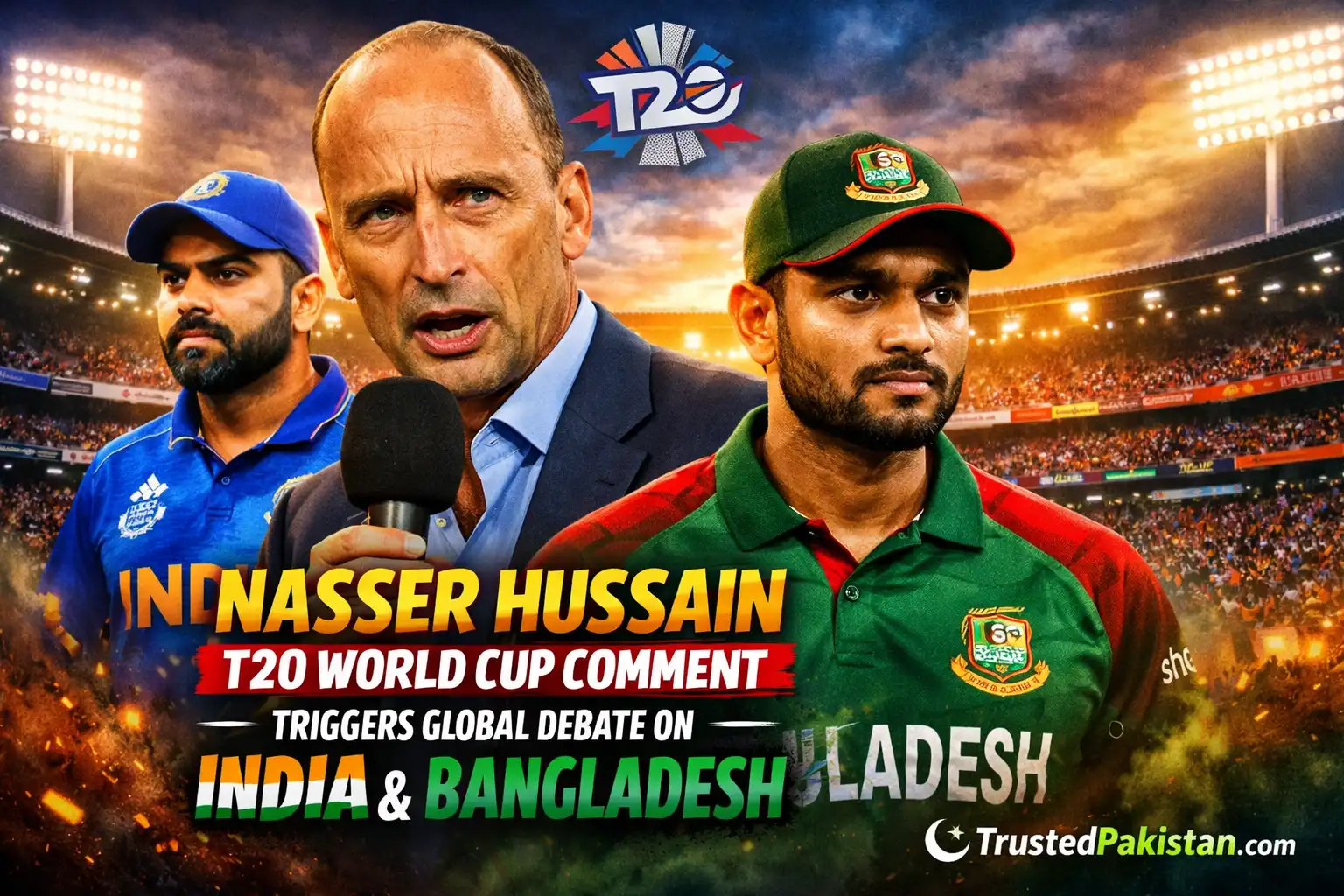
Nasser Hussain T20 World Cup Comment Triggers Global Debate on India and Bangladesh
The Nasser Hussain T20 World Cup Comment has become one of the most discussed talking points in international cricket, igniting debate across media, fans, and former players. Speaking candidly during a televised discussion, the former England captain questioned whether the International Cricket Council (ICC) would have reacted differently if India had made the same demand as Bangladesh regarding scheduling and match-related concerns in the T20 World Cup.
His remarks instantly went viral, raising uncomfortable questions about power imbalance in global cricket, the financial dominance of the Board of Control for Cricket in India (BCCI), and whether all member nations truly enjoy equal treatment under ICC regulations.
What Exactly Did Nasser Hussain Say?
During a post-match analysis show, Nasser Hussain openly suggested that Bangladesh’s request did not receive the same seriousness it might have if it had come from India.
He implied that:
- India’s commercial value gives it greater leverage
- Smaller boards often struggle to have their voices heard
- The ICC faces pressure when dealing with powerful cricket boards
This Nasser Hussain T20 World Cup Comment resonated deeply because it echoed what many insiders have quietly believed for years.
Context Behind Bangladesh’s Request
Bangladesh reportedly raised concerns related to:
- Match scheduling fairness
- Travel fatigue and recovery time
- Player welfare during the T20 World Cup
While such requests are not unusual in ICC tournaments, critics argue that Bangladesh’s concerns were sidelined instead of being fully addressed.
This led Hussain to pose the uncomfortable hypothetical:
“If this demand had come from India, would the response have been the same?”
Why This Comment Caused So Much Noise
1. India’s Financial Dominance
India contributes the largest share of ICC revenue through broadcasting rights, sponsorships, and viewership. This reality often fuels perceptions that:
- India holds disproportionate influence
- ICC decisions are financially driven
2. Historical Precedents
In past ICC tournaments, scheduling and venue decisions have sometimes been altered to accommodate India’s interests, reinforcing Hussain’s argument.



3. Unequal Power Dynamics
Smaller cricket boards like Bangladesh, Zimbabwe, and Afghanistan lack the same bargaining power, despite being full ICC members.
Global Reaction to Nasser Hussain T20 World Cup Comment
The cricketing world responded swiftly:
- Fans praised Hussain for “saying what others won’t”
- Former players largely agreed with his assessment
- Indian media defended the ICC’s neutrality
- Bangladesh supporters felt vindicated
This Nasser Hussain T20 World Cup Comment became more than an opinion — it turned into a mirror reflecting cricket’s governance issues.
ICC’s Official Position
The ICC has consistently maintained that:
- All member nations are treated equally
- Tournament decisions follow transparent processes
- Commercial interests do not override fairness
Expert Analysis | Is the Criticism Fair
Cricket analysts argue that while the ICC may not intentionally favor India, structural dependence on Indian revenue creates unavoidable bias.
Key points:
- Broadcast deals heavily rely on Indian viewership
- Sponsors prioritize India-centric schedules
- Neutrality becomes difficult in high-stakes tournaments
The Nasser Hussain T20 World Cup Comment highlights a systemic issue rather than attacking any single country.
Pakistan Angle | Regional Implications
In Pakistan, the debate struck a familiar chord. Pakistani fans and analysts have long argued that:
- South Asian cricket politics dominate ICC decisions
- Pakistan and Bangladesh face similar challenges
- Fair scheduling remains a persistent issue
Bigger Question Raised by This Debate
Instead of focusing solely on India or Bangladesh, the Nasser Hussain T20 World Cup Comment forces cricket authorities to confront a deeper question:
Can global cricket truly remain fair when financial power is so unevenly distributed?
Unless governance structures evolve, such controversies will continue to surface — louder and more frequently.
Final Perspective
What makes this episode significant is not controversy itself, but the honesty behind it. Nasser Hussain voiced a concern shared by millions of fans worldwide. Whether one agrees with him or not, his comment has undeniably reignited the conversation about fairness, transparency, and equality in international cricket — a conversation the ICC can no longer afford to ignore.
