


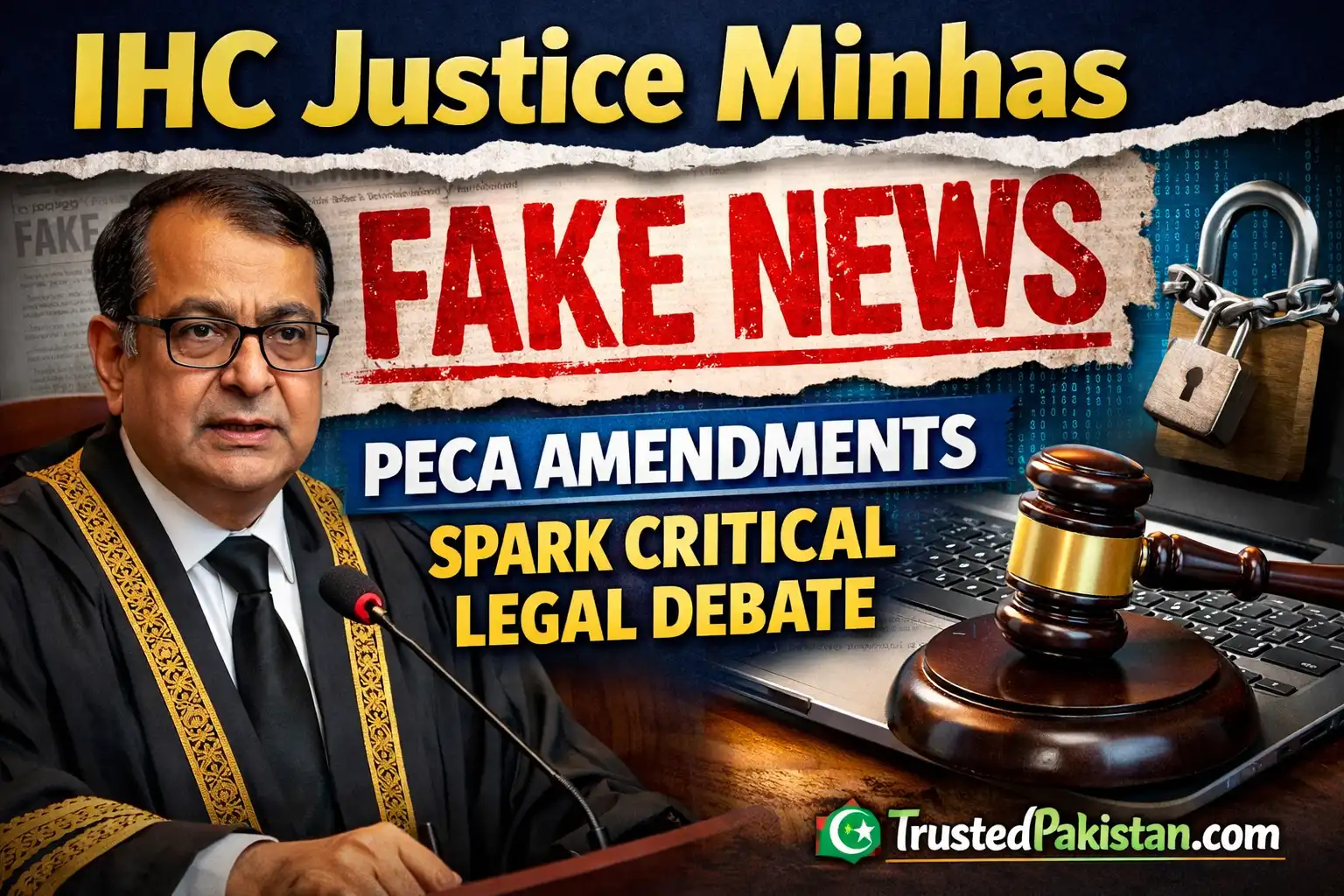
IHC Justice Minhas Fake News PECA Amendments Spark Critical Legal Debate
IHC Justice Minhas fake news PECA amendments became the center of national attention after Islamabad High Court Justice Sardar Ijaz Ishaq Minhas questioned how the state defines “fake news” under the amended Prevention of Electronic Crimes Act (PECA). His remarks exposed serious legal ambiguities, reigniting debate over freedom of expression, judicial oversight, and potential misuse of cybercrime laws in Pakistan.
During court proceedings, Justice Minhas asked a fundamental question: What exactly constitutes fake news, and who decides it? This single query has significant implications for journalists, digital media platforms, political activists, and ordinary citizens who rely on online spaces to express opinions.
Understanding PECA Amendments and Their Purpose
The Prevention of Electronic Crimes Act (PECA) was originally enacted to combat cybercrime, including hacking, identity theft, and online harassment. However, recent amendments expanded the scope of the law to include content deemed as “fake news,” particularly information that may allegedly cause panic, harm state institutions, or spread misinformation.
Critics argue that these amendments lack clear definitions and safeguards. The IHC Justice Minhas fake news PECA amendments debate highlights how vague legal language can threaten constitutional rights guaranteed under Article 19 of Pakistan’s Constitution.
Justice Minhas Raises Constitutional Concerns
Justice Minhas openly questioned whether the amended PECA law provides any objective criteria to determine fake news. He observed that without clear parameters, the law could be selectively enforced.
Key concerns raised include:
- Absence of a legal definition for “fake news”
- No independent oversight mechanism
- Potential suppression of dissenting voices
- Risk of criminalizing journalism and opinion
These observations suggest that the IHC Justice Minhas fake news PECA amendments issue is not merely legal but deeply constitutional.
Impact on Journalists and Digital Media
Pakistan’s media community has expressed alarm over the amendments. Journalists fear that investigative reporting could be labeled as fake news, leading to arrests, fines, or content takedowns.
Digital platforms, bloggers, and YouTubers are equally vulnerable. Without transparent standards, enforcement agencies could interpret criticism of public officials as misinformation. This reinforces why IHC Justice Minhas fake news PECA amendments are being watched closely by press freedom organizations.
Government’s Position on Fake News Regulation
The government maintains that the amendments are necessary to curb misinformation, especially during sensitive situations such as elections, national security incidents, or public emergencies.



Officials argue that fake news can destabilize society and undermine trust in state institutions. However, Justice Minhas’ questioning suggests that even legitimate objectives must comply with constitutional protections.
Legal Experts Weigh In
Legal analysts believe that the court’s scrutiny may lead to stricter judicial interpretation or even partial suspension of certain provisions.
According to constitutional lawyers:
- Laws affecting speech must be narrowly tailored
- Vague criminal provisions violate due process
- Judicial oversight is essential in digital regulation
The IHC Justice Minhas fake news PECA amendments discussion may ultimately shape future cyber laws in Pakistan.
International Standards and Free Speech
Globally, democratic states regulate misinformation with caution. International human rights frameworks emphasize that restrictions on speech must be lawful, necessary, and proportionate.
Justice Minhas’ remarks align with these principles, reinforcing Pakistan’s obligations under international conventions on civil and political rights.
Why This Case Matters for Ordinary Citizens
This is not just a media or legal issue. Social media users, students, activists, and professionals all face potential consequences if content is misinterpreted as fake news.
The IHC Justice Minhas fake news PECA amendments case sets a precedent for how digital speech will be governed in the coming years.
What Lies Ahead in the PECA Legal Challenge
As hearings continue, the Islamabad High Court may:
- Seek clearer definitions from the government
- Limit enforcement powers
- Emphasize constitutional safeguards
Instead of concluding the matter hastily, the court appears determined to balance state authority with civil liberties, signaling judicial maturity and restraint.
