


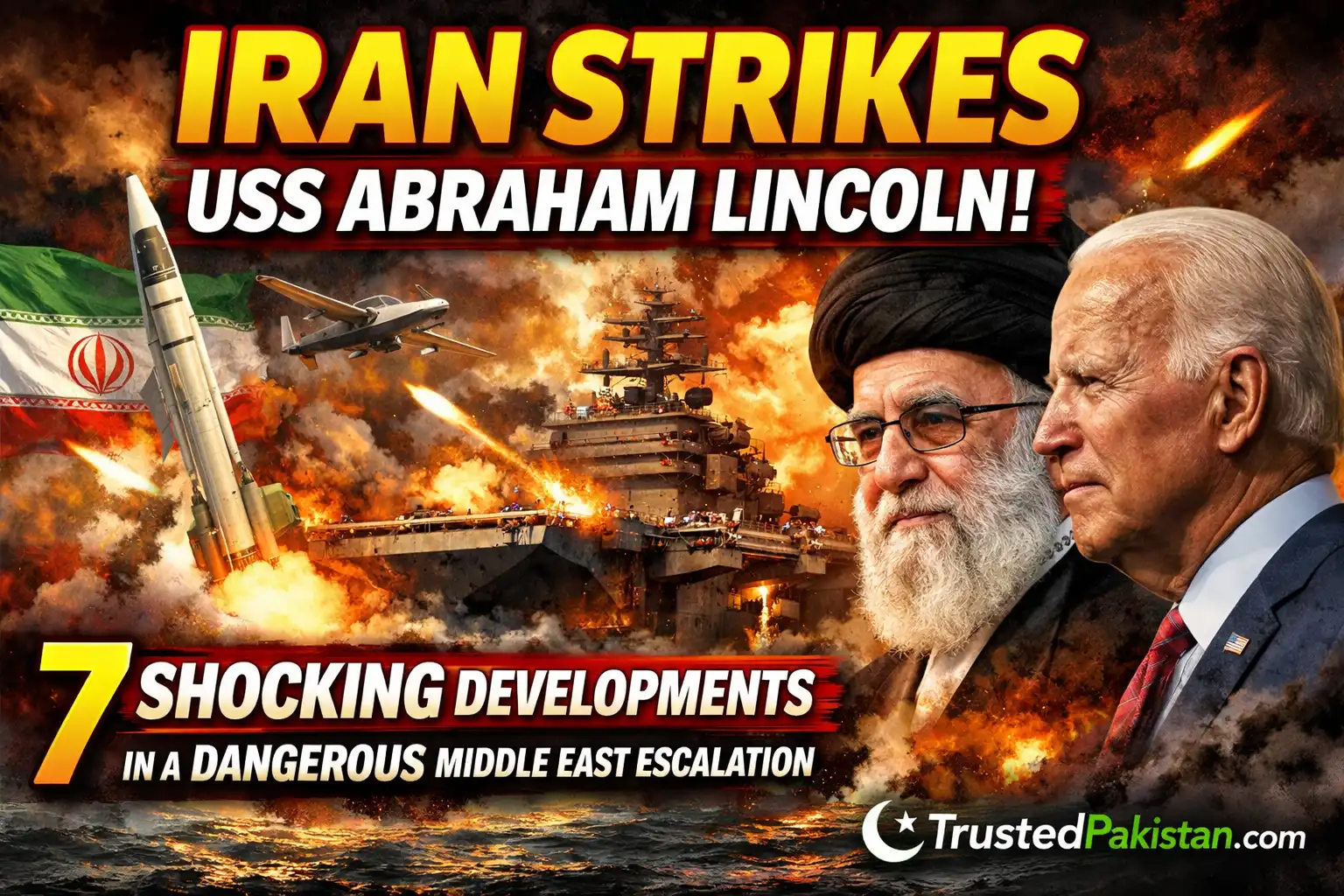
Iran Strikes USS Abraham Lincoln | 7 Shocking Developments in a Dangerous Middle East Escalation
Iran Strikes USS Abraham Lincoln has become a headline that is rapidly circulating across global media platforms. Iran’s Revolutionary Guards reportedly claimed that they “struck” the USS Abraham Lincoln using ballistic missiles, a statement that immediately intensified geopolitical tensions in the Middle East.
According to initial reports, the claim was broadcast through Iranian state-linked media outlets. However, independent confirmation from U.S. defense officials has remained limited, with Pentagon sources reportedly assessing the situation carefully before issuing formal statements.
The phrase Iran Strikes USS Abraham Lincoln signals a potentially dangerous shift in direct confrontation narratives between Tehran and Washington. Even if disputed, such claims carry significant strategic weight and psychological impact.
Iran Strikes USS Abraham Lincoln | Strategic Importance of the Aircraft Carrier
The USS Abraham Lincoln is a Nimitz-class aircraft carrier and one of the most powerful assets in the U.S. Navy. It represents not only military strength but also American presence and deterrence in volatile regions.
When headlines state Iran Strikes USS Abraham Lincoln, the implications go beyond a single naval vessel. Aircraft carriers serve as floating military bases, capable of launching fighter jets, surveillance aircraft, and supporting naval strike operations. Targeting such a vessel, or claiming to do so, sends a powerful message of defiance.
The carrier often operates in or near the Persian Gulf and surrounding waters, regions where tensions between Iran and the United States have historically escalated over sanctions, maritime security, and regional alliances.
Military Capabilities Behind the Claim
Iran Strikes USS Abraham Lincoln also brings attention to Iran’s ballistic missile program. Over the past decade, Iran has significantly expanded its missile capabilities, developing short-range and medium-range ballistic missiles capable of targeting regional military installations and naval assets.
Iran’s Revolutionary Guards have repeatedly emphasized their missile precision and defensive posture. Ballistic missiles, if used in maritime scenarios, would represent a serious escalation. However, striking a moving aircraft carrier in open waters requires advanced targeting systems, real-time intelligence, and sophisticated guidance technology.
The credibility of the claim depends heavily on technical feasibility. Aircraft carriers are protected by layered defense systems, including Aegis-equipped destroyers, missile interceptors, radar detection networks, and electronic warfare countermeasures.
The Iran Strikes USS Abraham Lincoln narrative may therefore be as much about strategic messaging as about kinetic military action.
Regional and Global Implications
If Iran Strikes USS Abraham Lincoln were confirmed as a successful attack, the geopolitical consequences would be severe. Such an action could trigger military retaliation, expanded naval deployments, and broader conflict scenarios.
The Middle East remains a complex web of alliances and rivalries. Iran maintains influence through regional partners and proxy groups, while the United States supports Gulf allies and maintains a significant military footprint.
An escalation at sea could disrupt oil shipping lanes, particularly in the Strait of Hormuz, through which a substantial portion of global oil supplies passes. Even unverified claims can increase insurance premiums, rattle markets, and elevate risk assessments across global supply chains.
U.S. Response and Defense Posture
In response to headlines such as Iran Strikes USS Abraham Lincoln, U.S. defense officials typically conduct damage assessments, verify radar and satellite data, and coordinate with allied naval forces.




The United States Navy operates under strict protocols designed to protect high-value assets. Carrier strike groups include guided-missile cruisers and destroyers equipped with missile defense systems capable of intercepting incoming threats.
Even if no physical strike occurred, such claims can alter operational patterns. Naval forces may adjust routes, increase readiness levels, and deploy additional surveillance assets.
The Pentagon’s communication strategy often seeks to prevent panic while maintaining deterrence. The phrase Iran Strikes USS Abraham Lincoln, therefore, carries diplomatic weight regardless of battlefield outcomes.
Impact on Global Markets and Security
Iran Strikes USS Abraham Lincoln is not only a military headline; it is also an economic one. Financial markets react quickly to signs of instability in energy-producing regions.
Oil prices typically rise when tensions escalate in the Persian Gulf. Investors factor in potential disruptions to shipping routes, refinery operations, and export terminals. Even rumors of confrontation can lead to volatility.
Defense stocks may also respond positively to increased military spending expectations, while broader equity markets could experience short-term uncertainty.
The strategic communication surrounding Iran Strikes USS Abraham Lincoln demonstrates how modern conflicts extend beyond physical battlefields into financial systems and digital information ecosystems.
What Comes Next in Middle East Tensions
Looking ahead, the Iran Strikes USS Abraham Lincoln claim may either fade as rhetoric or mark a turning point in U.S.-Iran relations. Diplomatic backchannels, regional mediation efforts, and international pressure could influence the trajectory.
Historically, periods of heightened rhetoric have alternated with cautious de-escalation. Both nations understand the catastrophic risks of direct, sustained conflict.
However, the psychological impact of asserting that Iran Strikes USS Abraham Lincoln cannot be underestimated. Strategic narratives shape public perception, alliance cohesion, and adversary calculations.
Military analysts will continue monitoring satellite imagery, naval movements, and official statements for clarity.
Emerging Cyber Warfare Concerns
Beyond ballistic missiles, a new dimension of conflict is increasingly relevant: cyber warfare. While the focus remains on the claim that Iran Strikes USS Abraham Lincoln, modern military confrontations often include cyber operations targeting communication networks, navigation systems, and infrastructure.
Cyber capabilities allow states to project power without conventional strikes. Disrupting naval command systems or defense networks can create strategic advantages without visible explosions.
As tensions rise, cybersecurity readiness becomes as critical as missile defense systems. The narrative of Iran Strikes USS Abraham Lincoln could expand beyond physical confrontation into digital domains, where attribution and accountability are more complex.
Understanding this broader battlefield is essential for policymakers and security experts evaluating risks in the current environment.
