


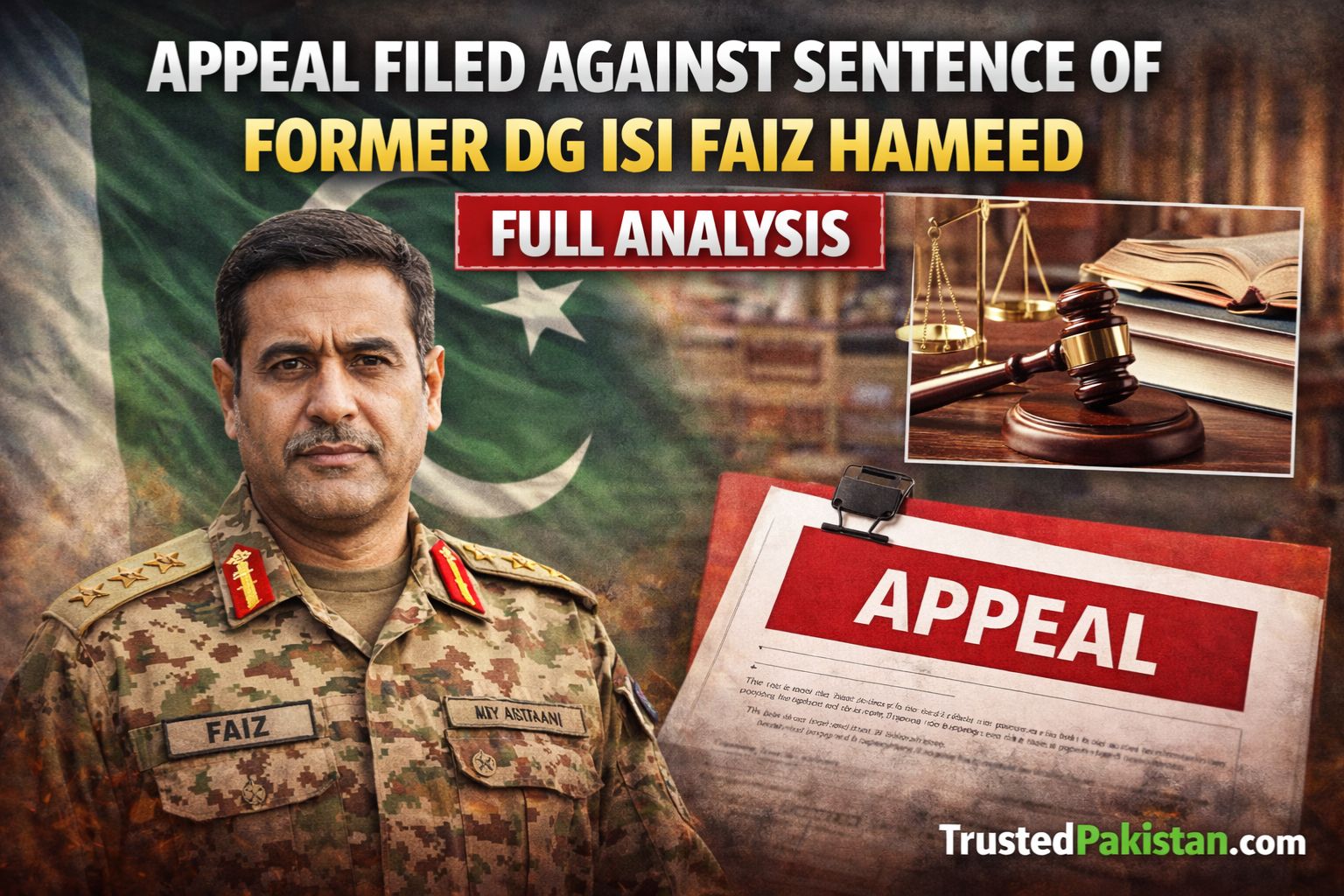
Appeal Filed Against Sentence of Former DG ISI Faiz Hameed | Full Analysis
Appeal Filed Against Sentence of Former DG ISI Faiz Hameed has become one of the most closely watched legal developments in Pakistan in recent years. The former head of Pakistan’s premier intelligence agency has formally challenged the 14-year sentence awarded to him by a military court, a move that has reignited debate over accountability, military justice, and civil-military relations in the country. The appeal, confirmed by his legal counsel, marks a critical next phase in a case that has already made history.
Background | Who Is Faiz Hameed?
Lieutenant General (Retd) Faiz Hameed served as the Director General of the Inter-Services Intelligence (ISI) from 2019 to 2021, a period marked by major regional and internal political developments. As ISI chief, he held one of the most influential positions within Pakistan’s security architecture, often operating at the intersection of intelligence, national security, and policy formulation.
Following his retirement, Faiz Hameed remained a prominent figure in public discourse, frequently cited in discussions on Pakistan’s civil-military dynamics. His conviction and subsequent appeal have therefore attracted attention not only because of the legal questions involved, but also due to his former stature within the military establishment.
Conviction and Sentencing by Military Court
On December 11, 2025, a Field General Court Martial (FGCM) sentenced Faiz Hameed to 14 years of rigorous imprisonment. According to official details reported by multiple media outlets, the military court found him guilty of several charges under the Pakistan Army Act and other relevant laws.
These charges reportedly included engaging in political activities after retirement, misuse of authority, violation of the Official Secrets Act, and actions that caused wrongful loss to individuals and institutions. The verdict was described by observers as unprecedented, as convictions of former intelligence chiefs by military courts are extremely rare in Pakistan’s history.
The sentencing triggered intense public debate, with supporters calling it a sign of accountability, while critics raised questions about transparency and due process.
Appeal Filed | What We Know So Far
The Appeal Filed Against Sentence of Former DG ISI Faiz Hameed was officially confirmed by his lawyer, Barrister Mian Ali Ashfaq, who stated that all legal requirements had been fulfilled before submitting the appeal. The appeal has been filed with the Registrar, Court of Appeals, AG Branch, under the provisions of the Pakistan Army Act.
Under military law, such appeals are reviewed by a designated appellate forum, which may include senior military officers authorized by the Chief of Army Staff (COAS). The appeal seeks a reassessment of the conviction and sentence, and could result in the verdict being upheld, reduced, or overturned.
Legal experts note that the filing of the appeal does not automatically suspend the sentence, but it does open the door for further legal scrutiny.



Legal Grounds and the Pakistan Army Act
Under Section 133B of the Pakistan Army Act, any individual sentenced to more than three months of imprisonment by a court martial has the right to file an appeal. This section provides a formal mechanism for reviewing military court decisions, ensuring that procedural and legal standards are met.
In addition to the military appeals process, legal analysts suggest that constitutional remedies may also be explored at a later stage. Such petitions typically focus on alleged violations of fundamental rights, jurisdictional issues, or concerns regarding fair trial guarantees under Pakistan’s Constitution.
The outcome of the appeal may therefore have broader implications for how military justice is interpreted and applied in high-profile cases.
TAP FOR MORE NEWS HERE
Public and Political Reactions
The case has sparked wide-ranging reactions across Pakistan’s political, legal, and media circles. Some commentators argue that the conviction demonstrates that no individual, regardless of rank or past position, is above the law. Others have expressed concern over the use of military courts and the limited public visibility into their proceedings.
The appeal has further intensified discussions around accountability mechanisms, transparency, and the balance between national security considerations and individual rights. Civil-military relations, already a sensitive topic in Pakistan, have once again moved to the center of national debate.
Implications for Pakistan’s Legal and Military System
The Appeal Filed Against Sentence of Former DG ISI Faiz Hameed carries significant implications beyond the individual case. Observers believe the appeal’s outcome could influence future handling of cases involving retired military officials, particularly those accused of political involvement or misuse of authority.
Key areas potentially affected include:
- Interpretation of the Pakistan Army Act
- Scope of accountability within military institutions
- Public perception of fairness and rule of law
- Long-term civil-military balance in governance
How the appellate forum addresses these issues may set important legal and institutional precedents.
Conclusion
The Appeal Filed Against Sentence of Former DG ISI Faiz Hameed represents a pivotal moment in Pakistan’s legal and military history. As the appeals process moves forward, attention will remain focused on whether the original verdict is upheld or revised. The case underscores the complexities of accountability, justice, and institutional authority in Pakistan, and its final outcome is likely to shape legal and political discourse for years to come.

