


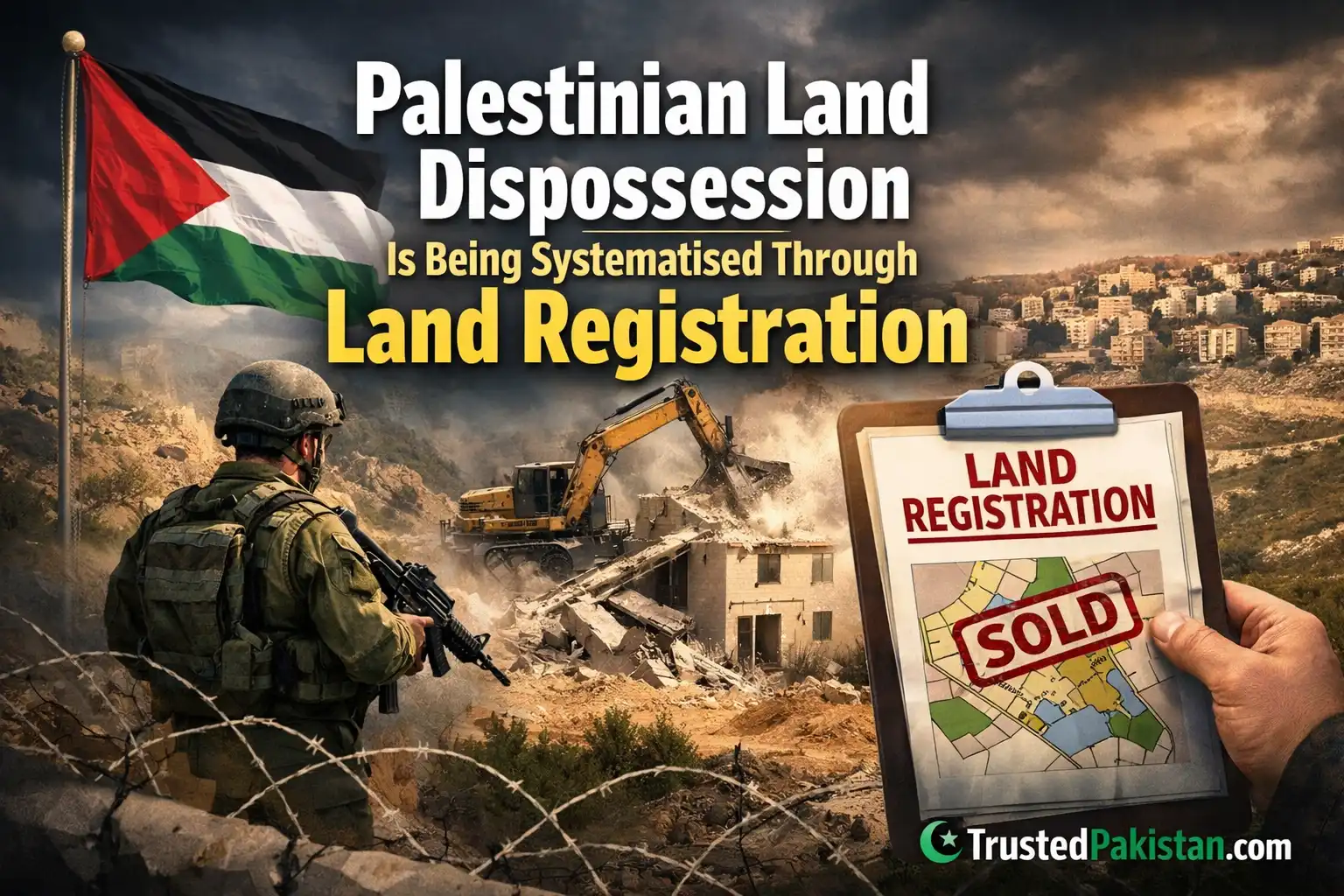
Palestinian Land Dispossession Is Being Systematised Through Land Registration
Palestinian Land Dispossession has become one of the most urgent and controversial issues in the occupied West Bank today. Human rights organisations and legal experts warn that Israel’s recent move to register land could further entrench Palestinian displacement. Critics argue that these measures may legalise long-standing settlement expansion while limiting Palestinian access to their own property.
This policy shift is being described as a dangerous step that “systematises dispossession” and could permanently reshape land ownership across Palestinian territories. While land registration may appear administrative on the surface, Palestinians fear it will become another mechanism for taking control of disputed areas.
What Is Palestinian Land Dispossession?
Palestinian Land Dispossession refers to the gradual loss of Palestinian-owned land due to occupation policies, settlement construction, legal restrictions, and forced displacement. Over the past several decades, Palestinians have experienced widespread land seizures, home demolitions, and the steady expansion of Israeli settlements across the West Bank.
Many Palestinian families depend on agricultural land for income and survival. Losing access to farmland or property does not only affect livelihoods, but also threatens identity, heritage, and long-term community stability. This ongoing process has contributed to shrinking Palestinian territorial presence and increasing fragmentation of Palestinian communities.
Israel’s Land Registration Policy Explained
Israel’s government has announced new efforts to formally register land in Area C of the West Bank, a region under full Israeli military and administrative control. Area C makes up more than 60% of the West Bank and contains most of its natural resources and open land.
Supporters of the policy claim that registration is meant to clarify land ownership and improve legal organisation. However, critics argue that the process functions as a political tool rather than a neutral legal reform. Palestinians worry that registering land under Israeli authority will transfer disputed property into Israeli legal frameworks and weaken Palestinian claims.
Experts say this could accelerate Palestinian Land Dispossession under the guise of legality, allowing Israeli authorities to classify more land as “state land” and expand settlement jurisdiction.
Why Palestinians Call It “Systematic Dispossession”
Palestinian officials and rights groups stress that land registration is not an equal process. Many Palestinians lack formal documentation for their land because of decades of military rule, restricted access to courts, and the disruption of normal civil administration.
Under the new registration procedures, undocumented Palestinian ownership may be dismissed, making it easier for Israeli authorities to confiscate land. This creates a system where Palestinians must prove ownership through paperwork that may not exist or may no longer be recognised.



As a result, Palestinian Land Dispossession becomes institutionalised rather than incidental, with legal structures reinforcing displacement over time.
Impact on West Bank Communities
For many Palestinian communities, land is not just property but the foundation of daily life. Land registration policies could result in farmers losing agricultural fields, villages being cut off from water resources, and Palestinian development becoming further restricted.
Settlement growth often brings additional military checkpoints, road closures, and security zones that limit Palestinian movement. Communities fear that these policies will intensify dispossession and leave Palestinians with shrinking space, fewer rights, and reduced opportunities for economic growth.
The impact is especially severe in rural areas, where land access is directly linked to survival. Many observers warn that continued dispossession could make Palestinian presence in large parts of the West Bank increasingly unsustainable.
TAP FOR MORE NEWS HERE
International Legal Concerns
International law largely considers the West Bank an occupied territory, and most of the international community views Israeli settlements as illegal. Critics argue that land registration policies violate principles outlined in the Fourth Geneva Convention and contradict multiple United Nations resolutions opposing settlement activity.
Humanitarian organisations have expressed concern that these measures could deepen inequality and create irreversible changes on the ground. More information on humanitarian conditions in the occupied Palestinian territories can be found through the United Nations Office for the Coordination of Humanitarian Affairs.
The Future of Palestinian Land Rights
If current trends continue, Palestinian Land Dispossession could become irreversible in many parts of the West Bank. Observers argue that without international accountability and legal protection, Palestinians may continue losing land through bureaucratic and legal mechanisms rather than direct military action.
To protect Palestinian land rights, human rights advocates call for stronger monitoring, legal advocacy, halting settlement expansion, and supporting Palestinian documentation efforts. The coming years will be critical in determining whether Palestinians can retain meaningful access to their land or face further displacement under institutional policies.
Palestinian Land Dispossession remains at the centre of the conflict, shaping not only present realities but also the future prospects of peace, justice, and territorial rights in the region.
