


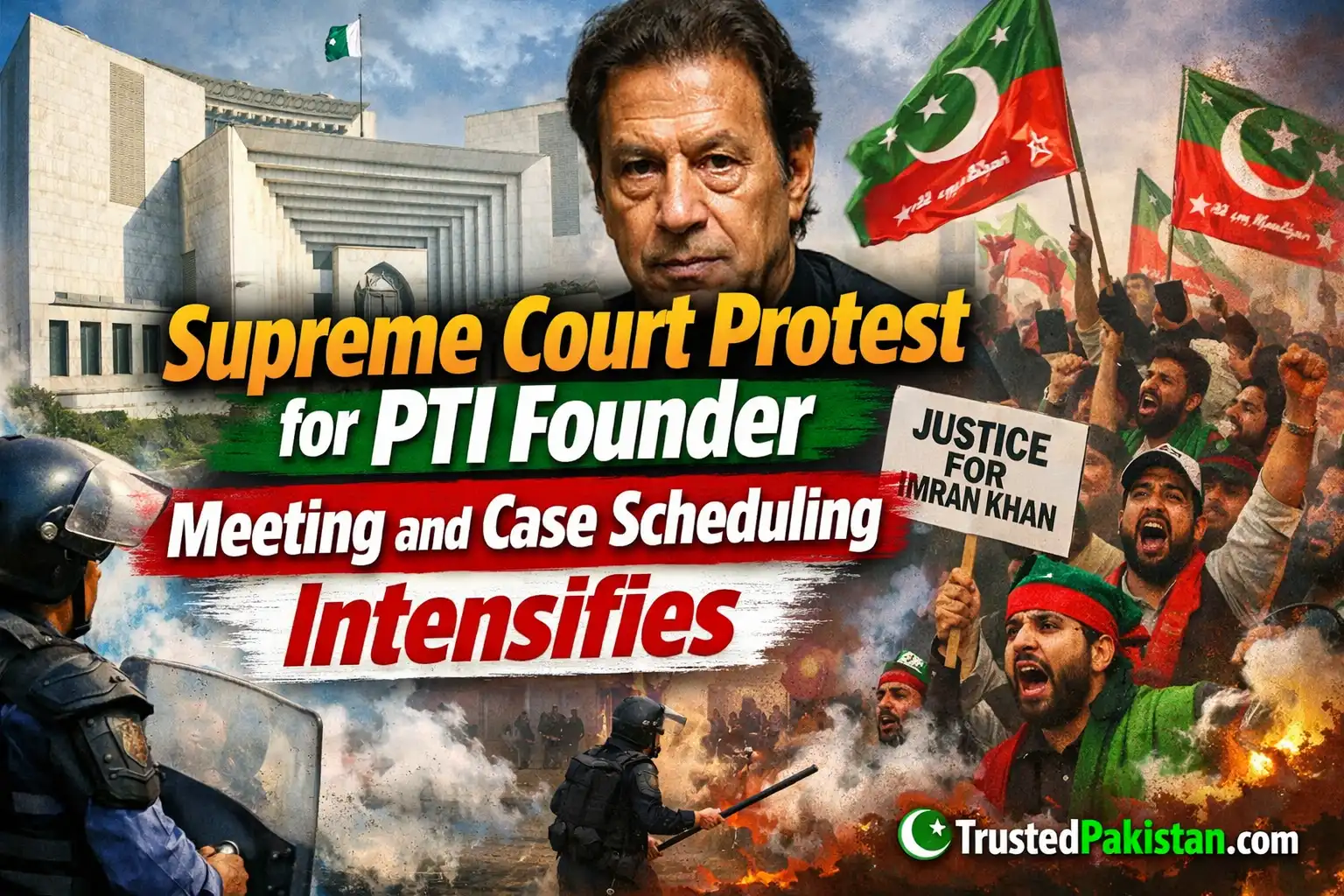
Supreme Court Protest for PTI Founder Meeting and Case Scheduling Intensifies
Supreme Court Protest for PTI Founder Meeting and Case Scheduling has taken center stage in Pakistan’s political landscape as party leaders and supporters gathered outside the apex court demanding immediate legal relief. The protest revolves around two central issues: arranging a meeting with the founder of Pakistan Tehreek-e-Insaf (PTI) and fixing pending legal cases for hearing without delay.
The demonstration reflects growing frustration among party members who believe that justice is being delayed. Protesters argue that timely hearings and access to legal counsel are fundamental constitutional rights.
Background of the Supreme Court Protest for PTI Founder Meeting and Case Scheduling
The Supreme Court Protest for PTI Founder Meeting and Case Scheduling began after several petitions related to the PTI founder remained pending. Party representatives claim that multiple cases have not been scheduled for hearing, creating legal uncertainty.
According to Pakistan’s judicial framework, the Supreme Court serves as the highest judicial authority. Details about the court’s structure and role can be found on the official Supreme Court of Pakistan website, which outlines constitutional responsibilities and case management procedures.
PTI leaders insist that their legal matters require urgent attention. They argue that prolonged delays undermine transparency and public trust in the judicial system.
Key Demands in the Supreme Court Protest for PTI Founder Meeting and Case Scheduling
Immediate Meeting with PTI Founder
One of the primary demands in the Supreme Court Protest for PTI Founder Meeting and Case Scheduling is permission for lawyers and party representatives to meet the detained founder. Protesters say such meetings are necessary for preparing legal strategies and ensuring fair representation.
Fixing Pending Cases for Hearing
Another major demand is the immediate scheduling of pending cases. Demonstrators argue that justice delayed is justice denied. They are calling for fixed hearing dates to ensure that legal proceedings move forward without unnecessary postponements.
Ensuring Constitutional Rights
Participants in the Supreme Court Protest for PTI Founder Meeting and Case Scheduling maintain that constitutional rights must be upheld. They emphasize access to legal counsel, transparent proceedings, and fair trials as essential components of democracy.
Legal and Political Implications
The Supreme Court Protest for PTI Founder Meeting and Case Scheduling carries significant legal and political implications. From a legal standpoint, the matter highlights concerns about case backlogs and procedural delays.
Politically, the protest signals heightened tensions between the opposition party and state institutions. Analysts believe that the outcome of these demands may influence public perception ahead of upcoming political developments.
The Constitution of Pakistan guarantees fundamental rights, including access to justice. The interpretation and enforcement of these rights remain central to the ongoing debate.




Government and Judicial Response
Authorities have maintained that legal procedures follow established rules and timelines. Officials argue that case scheduling depends on judicial priorities and workload.
While responding to the Supreme Court Protest for PTI Founder Meeting and Case Scheduling, government representatives have stressed respect for court processes. They assert that the judiciary operates independently and without political influence.
Security around the Supreme Court premises was tightened during the protest to maintain order and prevent unrest.
Public and Media Reaction
The Supreme Court Protest for PTI Founder Meeting and Case Scheduling has received widespread media coverage. Television channels, digital platforms, and print outlets reported on speeches delivered by party leaders outside the court.
Public opinion remains divided. Supporters view the protest as a legitimate demand for justice, while critics argue that judicial matters should not be influenced by public pressure.
For more updates on national political developments, visit our detailed coverage section on Pakistan Politics Updates.
What Happens Next?
The next steps in the Supreme Court Protest for PTI Founder Meeting and Case Scheduling depend largely on judicial decisions. If hearings are scheduled soon, tensions may ease. However, further delays could escalate political demonstrations.
Legal experts suggest that dialogue between stakeholders may help reduce confrontation. Constructive engagement can prevent institutional conflict and promote democratic stability.
Broader Impact on Democratic Institutions
The Supreme Court Protest for PTI Founder Meeting and Case Scheduling reflects broader concerns about governance, accountability, and institutional transparency in Pakistan.
Observers believe that how this situation unfolds will shape public trust in legal institutions. The balance between judicial independence and political accountability remains a sensitive issue.
The episode also underscores the importance of procedural efficiency in high-profile cases. Strengthening case management systems, increasing judicial capacity, and ensuring timely hearings could help prevent similar controversies in the future.
As Pakistan navigates complex political dynamics, the Supreme Court Protest for PTI Founder Meeting and Case Scheduling serves as a reminder that legal processes and democratic norms are deeply interconnected.
