


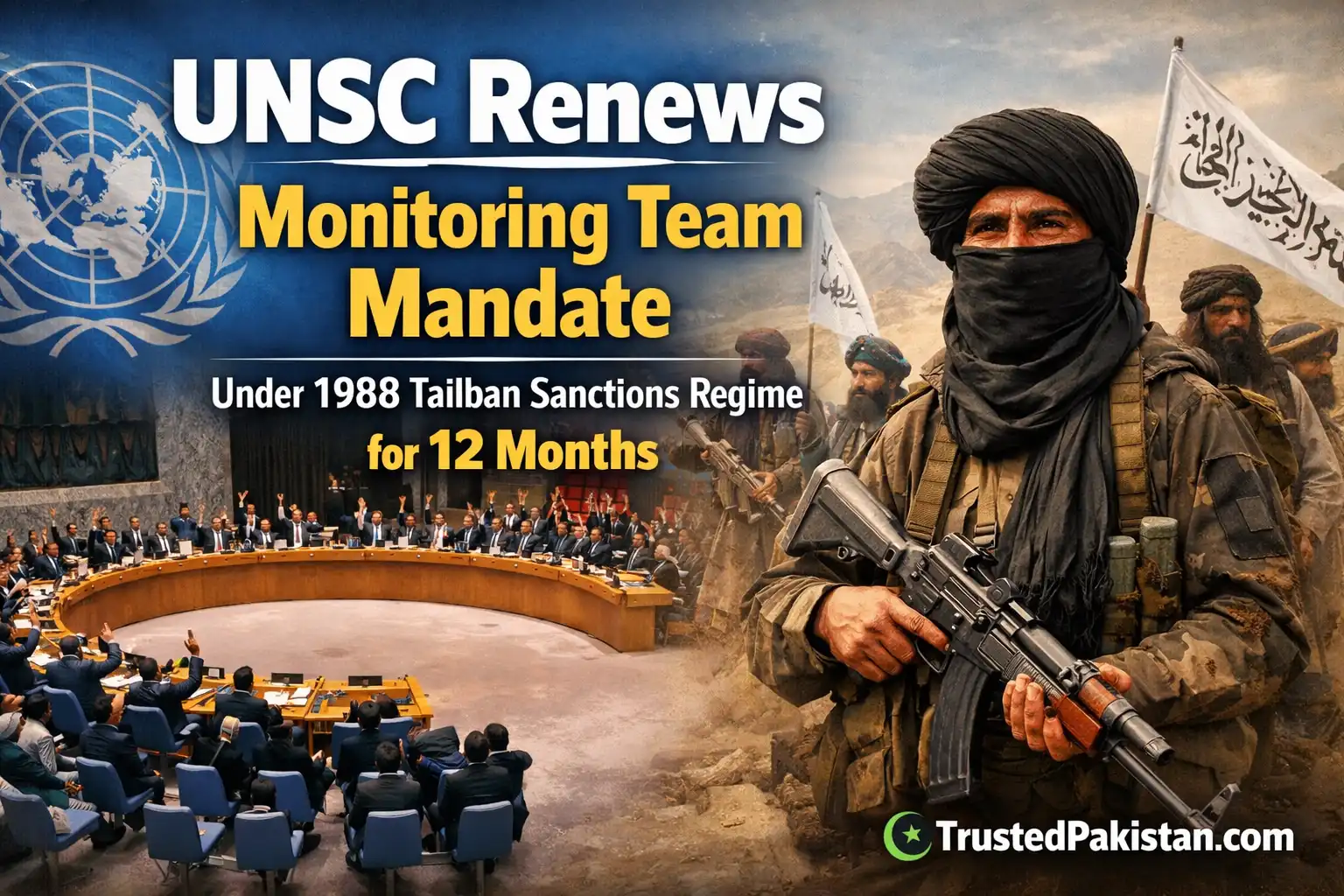
UNSC Renews Monitoring Team Mandate Under 1988 Taliban Sanctions Regime for 12 Months
The United Nations Security Council (UNSC) has renewed the mandate of the Monitoring Team operating under the 1988 Taliban sanctions regime for another 12 months, reflecting sustained international focus on Afghanistan’s evolving political and security environment. The decision highlights the Council’s continued commitment to sanctions oversight, compliance monitoring, and risk assessment amid persistent regional uncertainties.
The Monitoring Team serves as a critical component of the UN sanctions framework, providing analytical reports, evaluating enforcement effectiveness, and identifying emerging threats that may undermine regional stability. Its mandate renewal underscores the importance of maintaining structured monitoring mechanisms in a landscape shaped by complex governance, security, and humanitarian challenges.
Experts note that sanctions regimes depend heavily on credible monitoring bodies to ensure transparency and accountability. The Monitoring Team’s evaluations assist member states in understanding the implementation of restrictive measures while offering insights into broader security dynamics associated with Afghanistan.
Diplomatic observers interpret the extension as a recognition that Afghanistan remains central to global security and policy discussions. Continued political transitions, humanitarian pressures, and counterterrorism concerns have reinforced the need for sustained international engagement and oversight mechanisms.
Sanctions monitoring entities contribute to informed decision-making by gathering information from multiple sources, assessing compliance patterns, and highlighting developments that require policy attention. Their work plays a vital role in strengthening the credibility of multilateral governance structures.
Significance of the Monitoring Team’s Continued Work
The renewal of the Monitoring Team’s mandate emphasizes the importance of independent assessments within the United Nations sanctions architecture. By conducting detailed analyses and submitting periodic reports, the team enables the Security Council to evaluate sanctions effectiveness and emerging risks.
Monitoring mechanisms are widely regarded as essential tools for maintaining the integrity of international sanctions regimes. Accurate reporting helps policymakers adapt strategies to evolving geopolitical realities, ensuring that sanctions frameworks remain relevant and effective.
Beyond enforcement considerations, the Monitoring Team’s work also informs broader diplomatic discussions. Its findings often shape debates on conflict prevention, regional cooperation, and international security coordination.
Readers interested in global diplomatic developments and international policy analysis can explore related coverage on TrustedPakistan.com, where major geopolitical and security issues are examined in depth.
Experts further argue that monitoring activities provide valuable perspectives on unintended consequences of sanctions measures. Balanced evaluations assist the Security Council in aligning security objectives with humanitarian priorities.


Regional and Security Implications
Afghanistan’s internal developments continue to carry significant regional implications, particularly for neighboring countries. Security analysts warn that instability may contribute to cross-border risks, illicit financial flows, and evolving security threats.
Sustained monitoring frameworks are therefore viewed as preventive mechanisms that help identify emerging challenges before they escalate. Regular assessments support multilateral coordination and facilitate informed responses among member states.
Regional stakeholders maintain strong interests in Afghanistan’s stability due to geographic proximity, economic ties, and shared security concerns. Diplomatic initiatives and UN-led oversight mechanisms remain closely observed across South and Central Asia.
Experts observe that sanctions oversight and diplomatic engagement often function together within the United Nations’ broader conflict management approach. Monitoring efforts provide a factual foundation for policy dialogue and mediation initiatives.
UNSC Sanctions Framework and Oversight
The 1988 Taliban sanctions regime forms part of the United Nations Security Council’s broader strategy for addressing threats to international peace and security. Such frameworks typically combine targeted measures with expert monitoring to ensure compliance.
Sanctions systems are designed to remain adaptive, allowing for periodic review and refinement in response to changing conditions. Mandate renewals for monitoring bodies reflect this institutional flexibility.
For authoritative updates and official documentation, readers may consult the United Nations Security Council official platform, which publishes resolutions, reports, and statements concerning sanctions and monitoring activities.
Observers note that sanctions regimes represent policy instruments rather than permanent solutions. Their effectiveness depends on accurate assessments, diplomatic coordination, and consistent enforcement mechanisms.
Outlook and Continued International Focus
The extension of the Monitoring Team’s mandate indicates that Afghanistan-related developments will continue to receive close international attention. Policymakers emphasize the need for balanced strategies combining oversight, diplomacy, and humanitarian considerations.
Analysts argue that sustained multilateral engagement remains essential for addressing long-term stability challenges and supporting regional security frameworks. Monitoring mechanisms will continue to shape policy discussions within the Security Council.

