


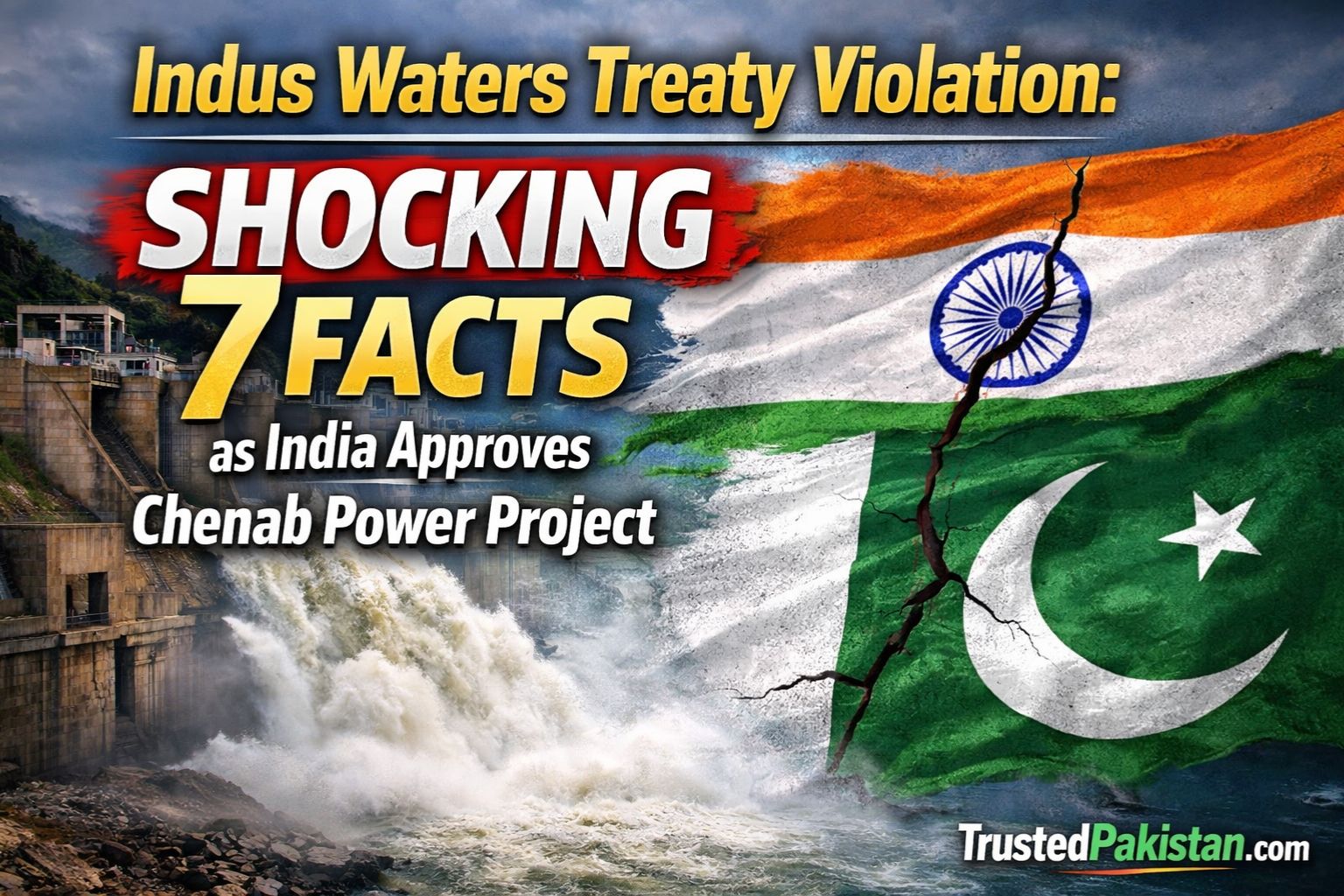
Indus Waters Treaty Violation | Shocking 7 Facts as India Approves Chenab Power Project
Indus Waters Treaty Violation has once again become a major point of tension between Pakistan and India after New Delhi approved a new hydropower project on the Chenab River. The decision has raised serious legal, political, and environmental concerns in Pakistan, where officials argue that India’s repeated actions undermine one of the world’s most important water-sharing agreements.
The Indus Waters Treaty, signed in 1960 with World Bank mediation, has long been considered a rare example of cooperation between the two rivals. However, the latest development has revived fears that India is gradually weakening the treaty through unilateral hydropower projects on rivers allocated to Pakistan.
Background of the Indus Waters Treaty
The Indus Waters Treaty (IWT) governs the sharing of six rivers of the Indus Basin between India and Pakistan. Under the treaty:
- India controls the eastern rivers: Ravi, Beas, and Sutlej
- Pakistan has rights over the western rivers: Indus, Jhelum, and Chenab
India is allowed limited use of western rivers only for run-of-the-river hydropower projects, provided these projects do not significantly alter water flow or storage. Any violation of these conditions is viewed by Pakistan as a clear Indus Waters Treaty Violation.
Indus Waters Treaty Violation: What Pakistan Claims
Pakistan argues that India’s approval of another hydropower project on the Chenab River represents a continuing Indus Waters Treaty Violation. According to water experts, the design features of Indian dams often include:
- Excessive water storage capacity
- Control over timing of water releases
- Potential manipulation during sowing seasons
These concerns are especially alarming for Pakistan, where agriculture depends heavily on consistent river flows.
India’s Chenab Hydropower Project Explained
The newly approved Chenab hydropower project is expected to generate substantial electricity for Indian-administered Jammu and Kashmir. India maintains that the project fully complies with treaty provisions and does not reduce Pakistan’s water share.
However, Pakistan disputes these claims, stating that technical designs allow India to temporarily block or divert water—an action that would amount to an Indus Waters Treaty Violation. Similar disputes have previously arisen over projects such as Kishanganga and Ratle.
Pakistan’s Official Response
Islamabad has strongly objected to the project through diplomatic and legal channels. Pakistani authorities have emphasized that continued Indus Waters Treaty Violation could force the country to:




- Seek arbitration under treaty mechanisms
- Involve the World Bank as a neutral mediator
- Raise the issue at international forums
Government officials warn that water security is a “red line” issue and cannot be compromised.
International Law and Treaty Obligations
Under international water law, upstream states are obligated to ensure equitable and reasonable use of shared rivers. Experts believe that repeated Indus Waters Treaty Violations weaken not only bilateral trust but also international norms governing transboundary water sharing.
The World Bank, as a guarantor of the treaty, has previously intervened by appointing neutral experts and arbitration courts. Observers believe similar intervention may become necessary if disputes escalate further.
Impact on Pakistan’s Water and Food Security
Pakistan is already among the world’s most water-stressed countries. Any disruption caused by an Indus Waters Treaty Violation could have severe consequences, including:
- Reduced irrigation for crops
- Threats to food security
- Increased economic pressure on farmers
Experts warn that even temporary flow manipulation on the Chenab River could affect millions of people downstream.
Regional Stability and Political Implications
Beyond water issues, the controversy has broader regional implications. Analysts note that repeated Indus Waters Treaty Violations could:
- Deepen political hostility
- Undermine confidence-building mechanisms
- Increase the risk of conflict escalation
Water disputes, once considered secondary, are now emerging as a core security challenge in South Asia.
What Comes Next?
Pakistan is expected to continue pressing its case through legal and diplomatic channels. Possible next steps include technical consultations, neutral expert review, or formal arbitration. The outcome will likely test the strength of the Indus Waters Treaty and the willingness of both countries to adhere to its principles.
Conclusion
The approval of India’s Chenab hydropower project has once again highlighted fears of an ongoing Indus Waters Treaty Violation. As climate change and water scarcity intensify, strict compliance with the treaty is more critical than ever. Preserving this agreement is essential not only for Pakistan’s water security but also for long-term regional stability in South Asia.
