


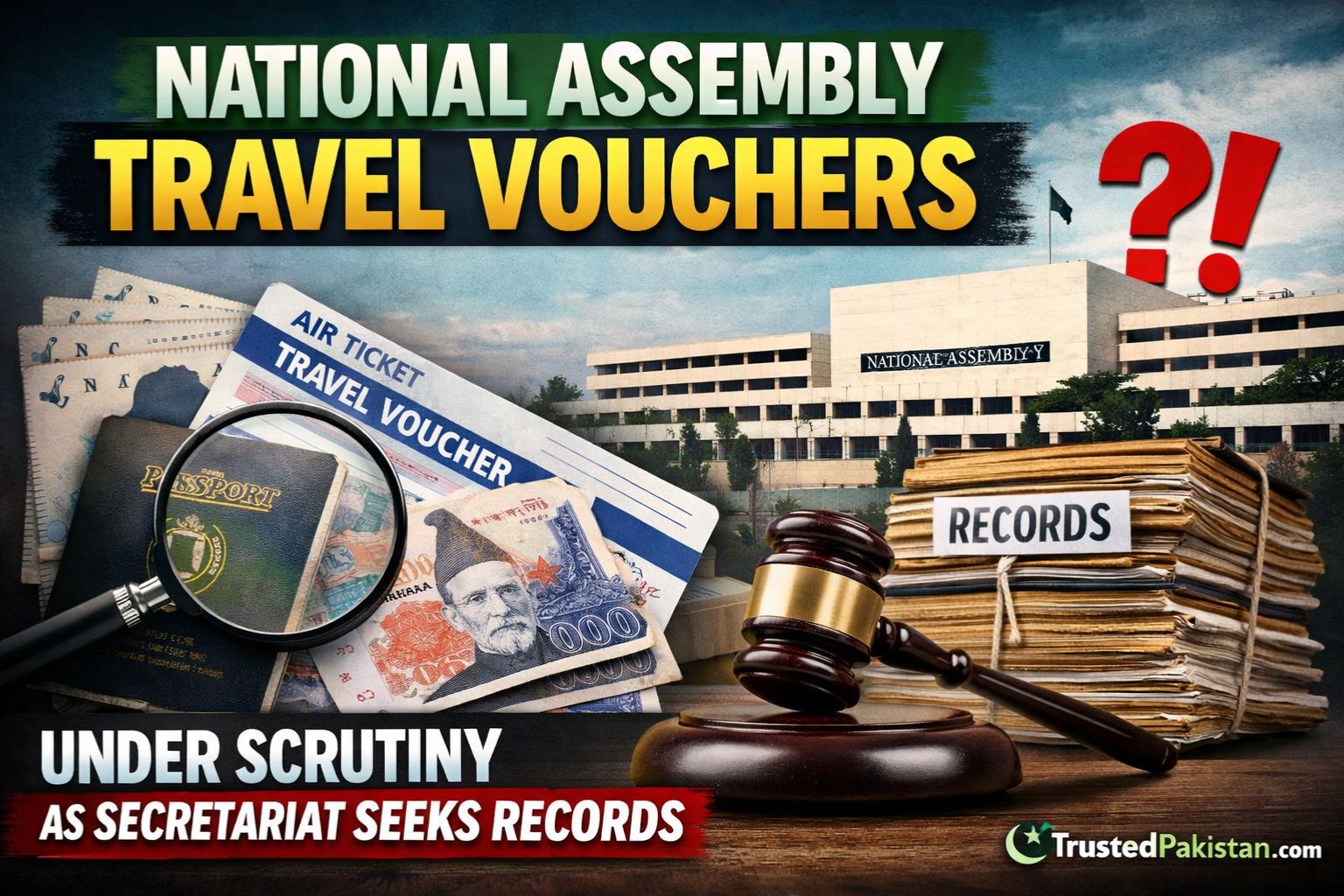
National Assembly Travel Vouchers | Under Scrutiny as Secretariat Seeks Records
National Assembly travel vouchers have emerged as a major point of discussion after the National Assembly Secretariat formally requested comprehensive details of travel vouchers submitted by members of parliament. The move has sparked concern and debate among lawmakers, raising important questions about transparency, accountability, and the broader implications for elected representatives in Pakistan.
This development comes at a time when public institutions across the country are facing growing pressure to demonstrate financial discipline, responsible governance, and transparency in the use of public funds. With increasing public awareness and media scrutiny, even routine administrative actions are being closely watched.
Background of the National Assembly Travel Vouchers Request
The National Assembly Secretariat recently issued an official notification asking lawmakers to provide complete records of National Assembly travel vouchers, including claims for both domestic and international travel. These vouchers typically cover expenses related to official parliamentary duties such as attending National Assembly sessions, committee meetings, official delegations, and government-assigned travel.
According to parliamentary sources, the request is part of an internal audit process aimed at reconciling financial records and ensuring that all reimbursements comply with established rules and procedures. Officials maintain that the process is administrative in nature and intended to improve record-keeping rather than target specific individuals.
Why Lawmakers Are Concerned
Despite official assurances, several members of the National Assembly have expressed unease over the sudden scrutiny of National Assembly travel vouchers. Some lawmakers fear that incomplete documentation, clerical errors, or missing records could lead to unnecessary complications or prolonged audits.
Others argue that many of the travel claims were submitted years ago, making it difficult to retrieve old receipts or supporting documents. There is also concern that the review process could be selectively interpreted or politicized, especially in the current charged political environment.
Key Concerns Raised by MNAs
- Lack of clarity regarding the scope and timeline of the review
- Potential misuse of audit findings for political pressure
- Absence of prior notice before demanding old records
- Fear of public misunderstanding of legitimate travel claims
Despite these concerns, some lawmakers have welcomed the move, calling it a necessary step toward improving financial transparency and institutional credibility.
TAP FOR MORE NEWS HERE
Official Position of the Secretariat
Officials from the National Assembly Secretariat insist that the review of National Assembly travel vouchers is a routine administrative exercise. They emphasize that similar audits have been conducted in the past and are essential for maintaining accurate and updated financial records.
A senior official stated that the Secretariat is merely fulfilling its responsibility to ensure that public funds are utilized in accordance with established financial rules.
Political and Legal Implications
The issue of National Assembly travel vouchers carries significant political and legal implications. If discrepancies or irregularities are identified, lawmakers may be asked to provide clarifications or return excess payments. In more serious cases, matters could be referred to relevant oversight or accountability bodies.



Politically, opposition parties may use the issue to criticize rivals, while the government could frame the audit as evidence of its commitment to transparency and good governance. As a result, what began as an administrative review could evolve into a broader political debate.
Transparency and Accountability Debate
Governance experts and public finance analysts argue that scrutiny of National Assembly travel vouchers is long overdue. They emphasize that elected representatives should be held to the highest standards when it comes to public spending.
Civil society organizations have also called for greater transparency, including the publication of summarized reports detailing parliamentary travel expenditures. Such measures, they argue, would strengthen public trust and reduce speculation.
Past Precedents in Parliamentary Audits
Pakistan’s parliamentary history includes several instances where financial audits triggered controversy. Reviews of allowances, perks, and benefits have previously led to public criticism and, in some cases, policy reforms.
Analysts believe that the current review of National Assembly travel vouchers could similarly result in updated reimbursement guidelines, improved documentation requirements, and stricter verification procedures in the future.
Expert Opinions
Legal and governance experts advise lawmakers to cooperate fully with the audit process while ensuring that due process and fairness are maintained. Transparency advocates note that proactive disclosure can help counter misinformation and prevent unnecessary political controversy.
“Financial accountability strengthens democratic institutions and public confidence,” said a governance expert while commenting on the issue.
What Happens Next?
In the coming weeks, members of the National Assembly are expected to submit the requested records related to their National Assembly travel vouchers. The Secretariat will review the submitted data and prepare an internal assessment report.
It remains unclear whether the findings will be made public or kept confidential. The level of transparency adopted at this stage will likely play a key role in shaping public perception and political discourse.
Conclusion
The scrutiny of National Assembly travel vouchers highlights the growing demand for transparency and accountability in Pakistan’s public institutions. While lawmakers’ concerns regarding procedural fairness and record availability are understandable, the review also presents an opportunity to strengthen financial oversight and rebuild public trust.
If handled impartially and transparently, the process could lead to improved governance standards and clearer reimbursement policies. However, if politicized, it risks deepening mistrust and controversy. Ultimately, the outcome will depend on how responsibly and fairly the audit is conducted — and whether accountability is pursued as a principle rather than a political tool.
