


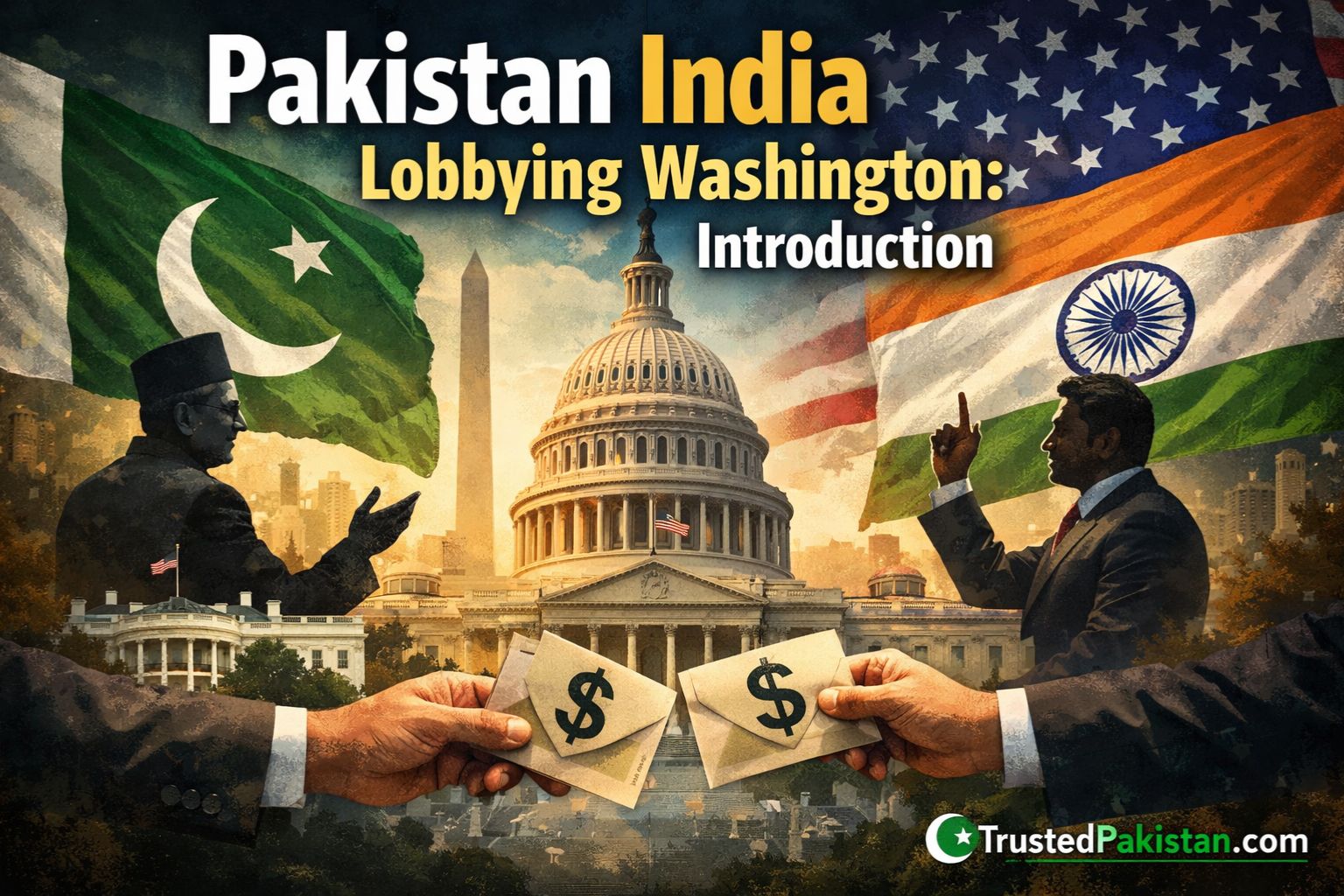
Pakistan India Lobbying Washington | Introduction
Pakistan India Lobbying Washington has emerged as a critical diplomatic instrument during periods of heightened military and political tensions between the two nuclear-armed neighbors. Whenever relations deteriorate—whether due to border clashes, airspace violations, or major security incidents—both Islamabad and New Delhi increasingly look beyond the region and toward Washington, DC, the world’s most influential power center.
As clashes intensified along disputed borders, both governments turned to powerful US-based lobbying and public relations firms to shape American opinion, influence policy debates, and manage media narratives. These efforts are not limited to government officials alone; they extend to think tanks, journalists, congressional staffers, and policy influencers who play a role in shaping Washington’s worldview.
The Foreign Agents Registration Act (FARA) filings provide rare and valuable transparency into how both countries attempted to influence American lawmakers and institutions during particularly sensitive moments.
What Is Pakistan India Lobbying Washington?
Pakistan India Lobbying Washington refers to the coordinated and often competing efforts by both governments to hire US lobbying, legal, and public relations firms to advance their respective national interests. This form of modern diplomacy operates behind the scenes and focuses on perception management as much as formal statecraft.
These activities typically include:
- Influencing US Congress members and committees
- Shaping US media narratives and public discourse
- Engaging think tanks, research institutes, and policy experts
- Countering rival diplomatic and security messaging
Such lobbying efforts intensify whenever regional security deteriorates, particularly during military stand-offs or diplomatic crises. In these moments, shaping Washington’s response becomes almost as important as developments on the ground in South Asia.
Role of FARA Filings in Exposing Diplomacy
FARA filings, maintained by the US Department of Justice, legally require foreign governments and their agents to disclose lobbying activities conducted on American soil. Through these mandatory disclosures, Pakistan India Lobbying Washington becomes visible to journalists, researchers, watchdog organizations, and policymakers.
These filings reveal crucial details such as:
- Names of contracted lobbying firms
- Financial payments and retainers
- Scope of work and messaging priorities
- Targeted US institutions and audiences
By examining FARA documents, observers can trace how diplomatic narratives evolve during crises and how both sides adjust their messaging in response to regional developments.
India’s Lobbying Strategy in Washington
According to FARA disclosures, India’s approach to Pakistan India Lobbying Washington has largely focused on reinforcing its image as a key strategic partner of the United States. Indian lobbying efforts emphasize long-term geopolitical alignment rather than crisis-only engagement.
Key themes promoted by Indian lobbyists include:



- Highlighting terrorism and national security concerns
- Strengthening defense and intelligence cooperation
- Presenting India as a stabilizing democratic force in South Asia
Major lobbying firms worked to brief US lawmakers, engage influential think tanks, and place opinion pieces in prominent media outlets. During periods of escalation, India’s lobbying efforts intensified around Capitol Hill, aiming to ensure US policy responses remained favorable or neutral.
Pakistan’s Diplomatic Outreach Through Lobbying
Pakistan’s strategy under Pakistan India Lobbying Washington has followed a different but equally calculated path. Islamabad’s lobbying efforts often focus on conflict de-escalation, international mediation, and highlighting humanitarian dimensions of regional disputes.
Key priorities promoted by Pakistani lobbying firms include:
- Raising awareness about Kashmir and human rights concerns
- Emphasizing the need for dialogue and regional stability
- Highlighting Pakistan’s counterterrorism cooperation
Islamabad’s representatives actively engaged US lawmakers and policy analysts to counter India’s dominant narrative and prevent unilateral policy positions that could further destabilize the region. These efforts aim to ensure Pakistan’s perspective remains part of Washington’s strategic calculations.
Key US Lobbying Firms Involved
FARA filings show that elite and well-connected lobbying firms operate on behalf of both sides under the umbrella of Pakistan India Lobbying Washington. These firms typically specialize in:
- Strategic communications and crisis management
- Legal advisory and compliance services
- Government relations and congressional outreach
Their work includes arranging private briefings, drafting policy memos, facilitating high-level meetings, and coordinating media engagement. This transforms Washington into a sophisticated diplomatic battleground where influence is exercised through access, messaging, and relationships.
Impact on US Foreign Policy
The influence of Pakistan India Lobbying Washington is visible in several aspects of US foreign policy, including:
- Carefully balanced congressional statements
- State Department calls for restraint and dialogue
- Neutral or measured responses during crises
While the United States generally avoids overt alignment with either side during escalations, lobbying efforts play a significant role in shaping tone, priorities, and diplomatic language used by American officials.
Why This Matters for South Asia
Understanding Pakistan India Lobbying Washington is essential because it directly affects how crises unfold beyond the region. Lobbying efforts influence:
- Crisis diplomacy and international mediation
- Global perception of regional conflicts
- Opportunities for conflict de-escalation
FARA filings demonstrate that modern diplomacy now extends far beyond embassies and official summits, relying heavily on influence networks in global power centers.
Conclusion
Pakistan India Lobbying Washington highlights how global capitals become arenas for regional rivalries. Through FARA filings, the public gains insight into diplomatic strategies that would otherwise remain hidden. As tensions between Pakistan and India persist, Washington will continue to serve as a crucial battleground for influence, narrative control, and strategic positioning.
