


US Military Iran Attack Developments Intensify as Decision Looms
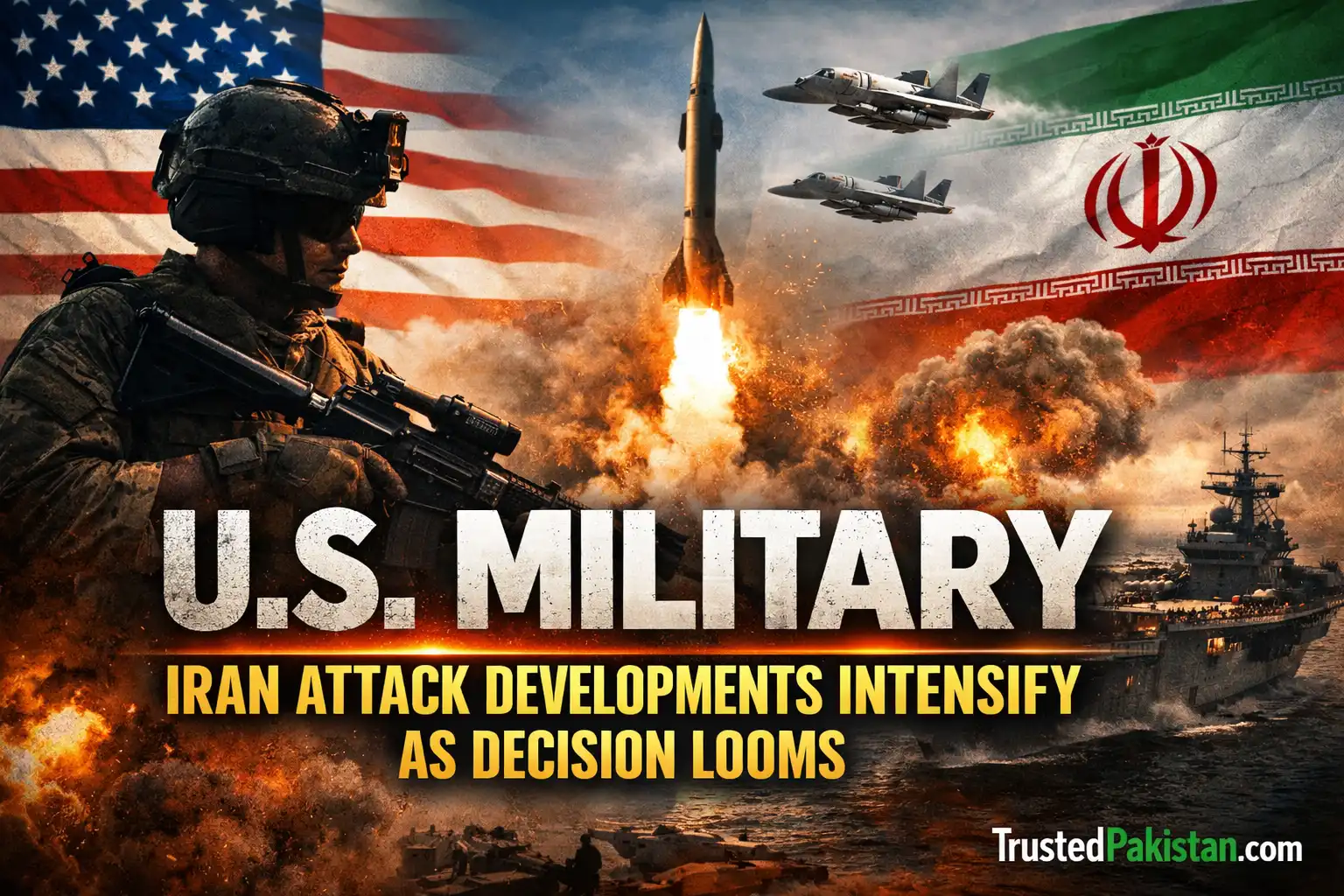
The US Military Iran Attack situation has escalated sharply after reports from CBS News revealed that American forces are prepared for potential military action against Iran by Saturday. However, President Donald Trump has not yet made a final decision regarding the timing of any strike.
This emerging crisis has raised serious geopolitical concerns across the Middle East and beyond. Military analysts, policymakers, and global markets are closely monitoring the developments surrounding the US Military Iran Attack possibility.
Background of the US Military Iran Attack Situation
The US Military Iran Attack narrative stems from rising tensions between Washington and Tehran. Over recent months, political disagreements, regional conflicts, and security incidents have intensified the standoff.
The United States has accused Iran of destabilizing activities in the region. Iran, on the other hand, has criticized American sanctions and military presence near its borders. These escalating tensions have led to heightened military preparedness on both sides.
Reports indicate that US defense officials have finalized operational plans, positioning assets strategically in the region in case authorization is granted.
What CBS Reported About Military Readiness
According to CBS News, the US Military Iran Attack plans could be activated as early as Saturday. Military forces are reportedly in place and awaiting presidential authorization.
The report suggests:
- Strike options have been finalized.
- US forces in the region are on high alert.
- Strategic assets, including naval and air units, are positioned.
- Intelligence assessments are ongoing.
The readiness does not necessarily mean immediate action. Instead, it signals strategic preparedness while political leadership evaluates risks and consequences.
Why Trump Has Not Made a Final Decision
Despite the advanced stage of planning, President Trump has not yet confirmed whether the US Military Iran Attack will proceed.
Several factors may explain the delay:
1. Diplomatic Calculations
Backchannel negotiations may still be active. Military action could close doors to diplomatic solutions.
2. Domestic Political Considerations
Any US Military Iran Attack would carry domestic political implications, especially in an election-sensitive climate.
3. Global Reaction Risks
An attack could trigger retaliation from Iran or its regional allies, expanding the conflict.
4. Economic Impact
Oil markets are extremely sensitive to Middle East instability. A military strike could disrupt global supply chains.
The President’s decision-making process reportedly involves consultations with defense advisors, intelligence agencies, and allied governments.
Regional and Global Implications
The US Military Iran Attack scenario has far-reaching consequences.
Middle East Stability
Iran holds strategic influence across Iraq, Syria, Lebanon, and Yemen. Any strike could provoke responses across multiple theaters.
US Allies in the Region
Countries hosting US military bases could become potential targets. Regional governments are therefore monitoring developments carefully.


Global Powers
Russia and China have diplomatic and economic ties with Iran. A military confrontation could shift global alliances and increase tensions between major powers.
Military Capabilities and Strategic Options
The US Military Iran Attack would likely rely on precision airstrikes rather than ground invasion.
Potential options may include:
- Targeted strikes on military installations
- Cyber operations
- Naval blockades
- Strategic deterrence demonstrations
The US military maintains advanced surveillance and long-range strike capabilities in the region. However, Iran also possesses missile systems and proxy networks that could respond asymmetrically.
Defense experts warn that even a limited strike could escalate rapidly.
Diplomatic Efforts Behind the Scenes
While military preparations continue, diplomatic engagement may still be underway.
Historically, tensions between Washington and Tehran have fluctuated between confrontation and negotiation. The US Military Iran Attack readiness may serve as leverage in diplomatic talks rather than a guaranteed step toward war.
International organizations and European allies are reportedly urging restraint. Diplomatic channels through intermediaries remain possible.
What Happens Next?
Several scenarios remain possible:
- The President authorizes a limited strike.
- Military readiness continues without action.
- Diplomatic breakthrough reduces tensions.
- A triggering incident accelerates escalation.
The US Military Iran Attack discussion reflects strategic signaling as much as operational planning. Military readiness does not automatically translate into immediate conflict.
Observers believe the coming days will be critical in determining the direction of US-Iran relations.
Impact on Energy Markets and Global Stability
Energy markets are highly sensitive to instability in the Gulf region. The Strait of Hormuz, through which a significant portion of global oil shipments passes, could become a flashpoint.
A confirmed US Military Iran Attack would likely cause:
- Oil price volatility
- Stock market fluctuations
- Increased insurance costs for shipping
- Heightened regional security alerts
Investors and governments are closely analyzing the situation for signs of escalation or de-escalation.
Strategic Military Signaling in Modern Warfare
The US Military Iran Attack situation also highlights a broader shift in modern warfare strategy. Military mobilization today often serves as political signaling.
Preparedness can act as leverage. Strategic ambiguity may pressure adversaries without actual engagement.
Whether the United States proceeds with military action or opts for diplomatic solutions, this development underscores the delicate balance between deterrence and escalation in global politics.
As the deadline mentioned in reports approaches, international observers await clarity from the White House regarding the future of the US Military Iran Attack plans.
