


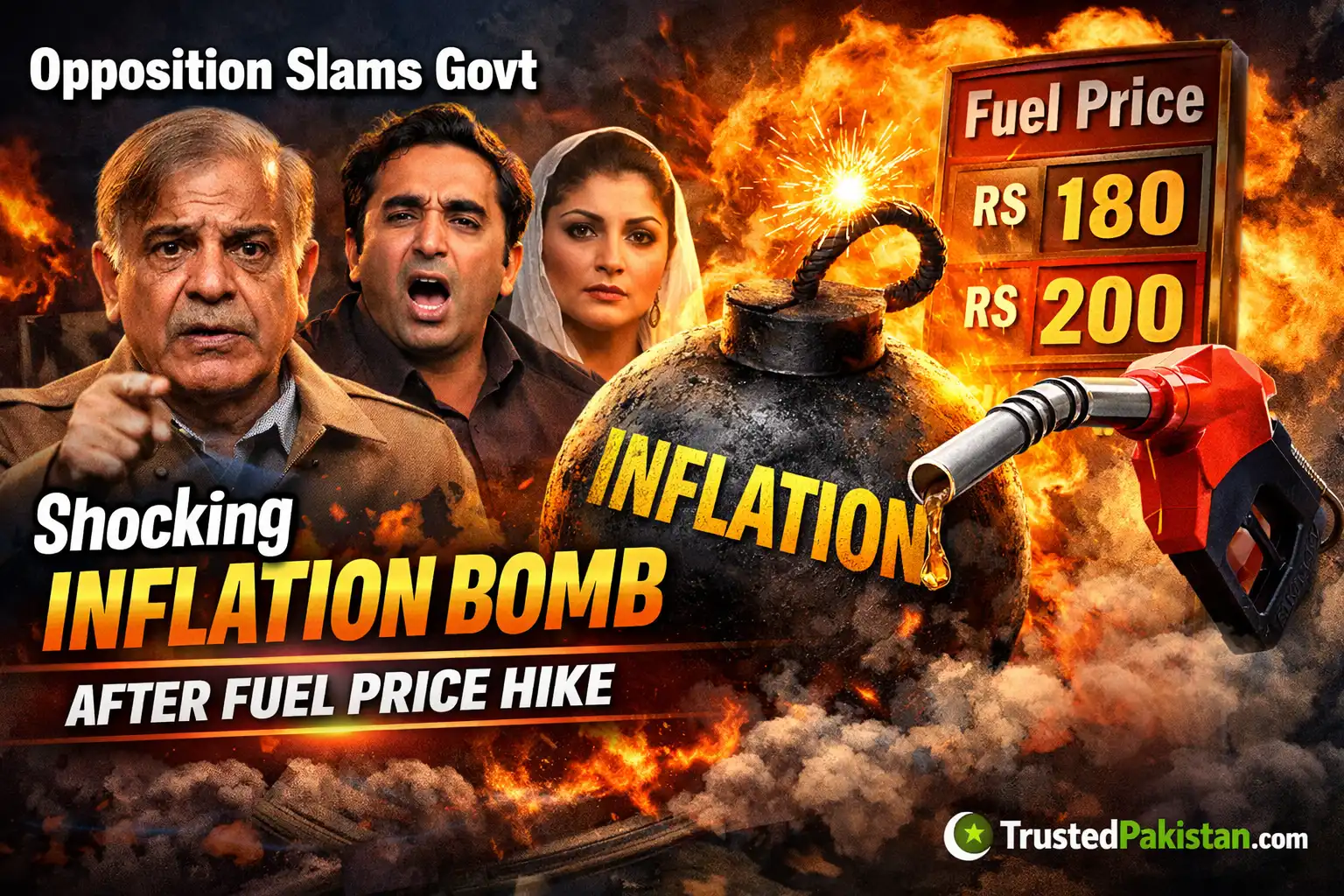
Opposition Slams Govt Shocking Inflation Bomb After Fuel Price Hike
The inflation bomb after fuel price hike announced by the government has triggered strong criticism from opposition parties across Pakistan. Political leaders have accused the government of placing an unbearable financial burden on citizens who are already struggling with rising inflation and economic uncertainty.
The recent increase in petrol and diesel prices has sparked nationwide debate. Opposition leaders say the decision will not only raise transportation costs but will also push the prices of essential goods even higher.
Opposition Criticizes Inflation Bomb After Fuel Price Hike
Opposition parties have strongly condemned what they describe as an inflation bomb after fuel price hike, calling the move irresponsible and harmful for ordinary Pakistanis.
Several opposition leaders argued that the government has failed to provide relief to citizens despite repeated promises of economic stability. They claim the fuel price increase will worsen the cost-of-living crisis.
According to opposition representatives, the decision reflects poor economic planning and a lack of concern for low-income households.
For more updates on political developments in Pakistan, visit our internal coverage on government policy debates.
Economic Impact of the Fuel Price Increase
Experts warn that the inflation bomb after fuel price hike could trigger a chain reaction across multiple sectors of the economy.
Fuel prices directly influence transportation costs, manufacturing expenses, and agricultural production. When fuel becomes expensive, businesses typically pass the additional cost to consumers.
As a result, essential commodities such as food items, vegetables, and daily household products may become more expensive.
Economic analysts also fear that inflation could rise further in the coming months if fuel prices remain high.
Global economic institutions such as the International Monetary Fund often emphasize the importance of stable fuel pricing policies to control inflation and maintain economic balance.
Public Reaction to the Inflation Bomb After Fuel Price Hike
The inflation bomb after fuel price hike has also generated widespread public concern. Citizens across various cities have expressed frustration over the rising cost of living.
Many people believe that the fuel price increase will directly affect their daily expenses, particularly transportation and food prices.
Workers, small business owners, and transport operators say the move will reduce their earnings while increasing operational costs.
Public dissatisfaction is particularly visible on social media, where citizens are demanding immediate relief measures.


Government’s Justification for the Decision
Despite criticism, government officials have defended the decision related to the inflation bomb after fuel price hike.
Officials claim that the increase in fuel prices is linked to global oil market fluctuations and economic agreements with international financial institutions.
According to government sources, maintaining fuel subsidies would put additional pressure on Pakistan’s already strained national budget.
They argue that difficult economic decisions are necessary to stabilize the country’s financial situation.
However, critics insist that the government should focus on alternative policies to reduce the burden on citizens.
TAP FOR MORE NEWS HERE
Political Pressure and Demand for Reversal
Opposition leaders have demanded an immediate reversal of the inflation bomb after fuel price hike, warning that the decision could worsen public anger.
Several political parties are considering protests and parliamentary action to challenge the move.
They argue that the government must prioritize public welfare and introduce relief packages for vulnerable communities.
Analysts believe the issue could become a major political challenge if inflation continues to rise.
The debate surrounding the fuel price increase may also influence upcoming political developments in the country.
What This Means for Pakistan’s Economy
The inflation bomb after fuel price hike highlights the complex challenges facing Pakistan’s economy.
Balancing fiscal stability while protecting citizens from rising living costs remains a difficult task for policymakers.
Economists suggest that long-term solutions should include improving energy policies, increasing domestic production, and strengthening economic management.
Without structural reforms, Pakistan may continue facing cycles of inflation and economic instability.
The current controversy surrounding fuel prices reflects deeper economic issues that require comprehensive policy responses in the coming years.
