


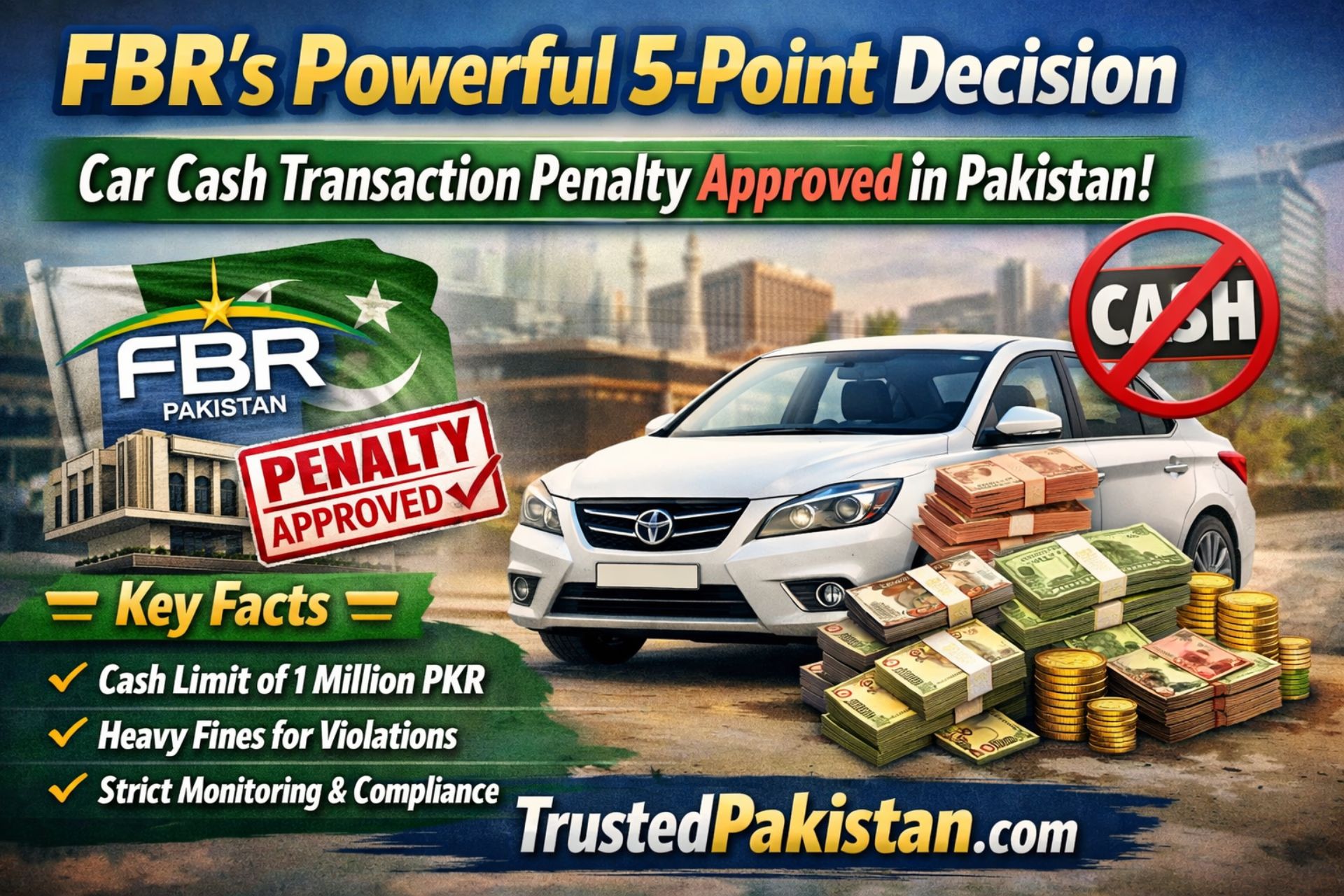
FBR’s Powerful 5-Point Decision | Car Cash Transaction Penalty Approved in Pakistan
FBR car cash transaction penalty has been formally approved in a major policy move aimed at curbing undocumented economic activity in Pakistan. The Federal Board of Revenue (FBR) has taken a decisive step to discourage the cash-based buying and selling of vehicles by approving penalties on such transactions, signaling a stronger push toward a fully documented economy.
The decision is being seen as part of broader tax reforms intended to improve transparency, increase revenue collection, and reduce tax evasion in one of Pakistan’s largest informal markets—the automobile.
FBR Car Cash Transaction Penalty: What Has Been Approved?
Under the newly approved policy, penalties will be imposed on individuals and dealers involved in cash-based vehicle transactions beyond specified limits. The FBR car cash transaction penalty aims to ensure that all high-value vehicle purchases are conducted through banking channels, including cheques, bank transfers, or other traceable digital payment methods.
According to officials, the move will allow tax authorities to track financial flows more efficiently and identify discrepancies between declared income and actual spending.
The FBR has clarified that the policy will apply to both new and used vehicle sales, covering individual buyers, sellers, and automobile dealers.
Why FBR Car Cash Transaction Penalty Was Introduced
The automobile market in Pakistan has long been criticized for its heavy reliance on cash, making it difficult for authorities to document transactions properly. The FBR car cash transaction penalty has been introduced to address the following concerns:
- Widespread tax evasion
- Money laundering risks
- Lack of transaction transparency
- Underreporting of income
- Weak documentation of assets
According to the Federal Board of Revenue , undocumented cash flows significantly weaken Pakistan’s tax base and undermine economic reforms.
How the New Penalty System Will Work
While the exact penalty amounts will be notified separately, sources indicate that fines may be imposed as a percentage of the transaction value if vehicle purchases are made in cash beyond the permitted threshold.
Key highlights of the FBR car cash transaction penalty framework include:
- Mandatory use of banking channels for vehicle payments
- Reporting obligations for car dealers
- Enhanced audit powers for FBR
- Data sharing with banks and excise departments
Experts believe that digital transaction records will help authorities detect tax irregularities more effectively.


Impact on Car Buyers and Dealers
The implementation of the FBR car cash transaction penalty is expected to significantly change how vehicles are bought and sold in Pakistan.
For Buyers:
- Greater reliance on bank accounts
- Increased documentation requirements
- Reduced scope for under-the-table deals
For Dealers:
- Mandatory reporting of transactions
- Compliance with tax documentation laws
- Potential penalties for non-compliance
Industry analysts believe that while the transition may cause short-term inconvenience, it will bring long-term stability and credibility to the automobile market.
FBR Car Cash Transaction Penalty and the Documented Economy
The FBR car cash transaction penalty aligns with Pakistan’s broader goal of shifting toward a documented and digital economy. Similar steps have already been taken in sectors like real estate, banking, and retail.
According to the State Bank of Pakistan , reducing cash-based transactions is essential to controlling inflation, improving monetary policy effectiveness, and preventing illicit financial flows.
Government officials argue that documenting vehicle transactions will also help authorities track luxury spending and unexplained wealth more accurately.
Criticism and Concerns
Despite its objectives, the FBR car cash transaction penalty has drawn some criticism. Opponents argue that:
- Many citizens remain unbanked
- Banking access in rural areas is limited
- Sudden enforcement may burden small traders
However, FBR officials maintain that gradual implementation and public awareness campaigns will help address these concerns.
What This Means for Pakistan’s Economy
The approval of the FBR car cash transaction penalty represents a strong policy signal that Pakistan is serious about tax reforms and accountability. Economists believe that documenting large transactions like vehicle purchases can significantly improve revenue collection and investor confidence.
For more updates on Pakistan’s economic reforms, read our internal coverage on
Pakistan tax policy and FBR reforms.
Conclusion
The FBR car cash transaction penalty marks a powerful shift in Pakistan’s approach to regulating high-value transactions. By discouraging cash-based vehicle purchases, the government aims to strengthen transparency, curb tax evasion, and move closer to a sustainable documented economy. While challenges remain, experts agree that consistent enforcement and public cooperation will determine the success of this landmark decision
