


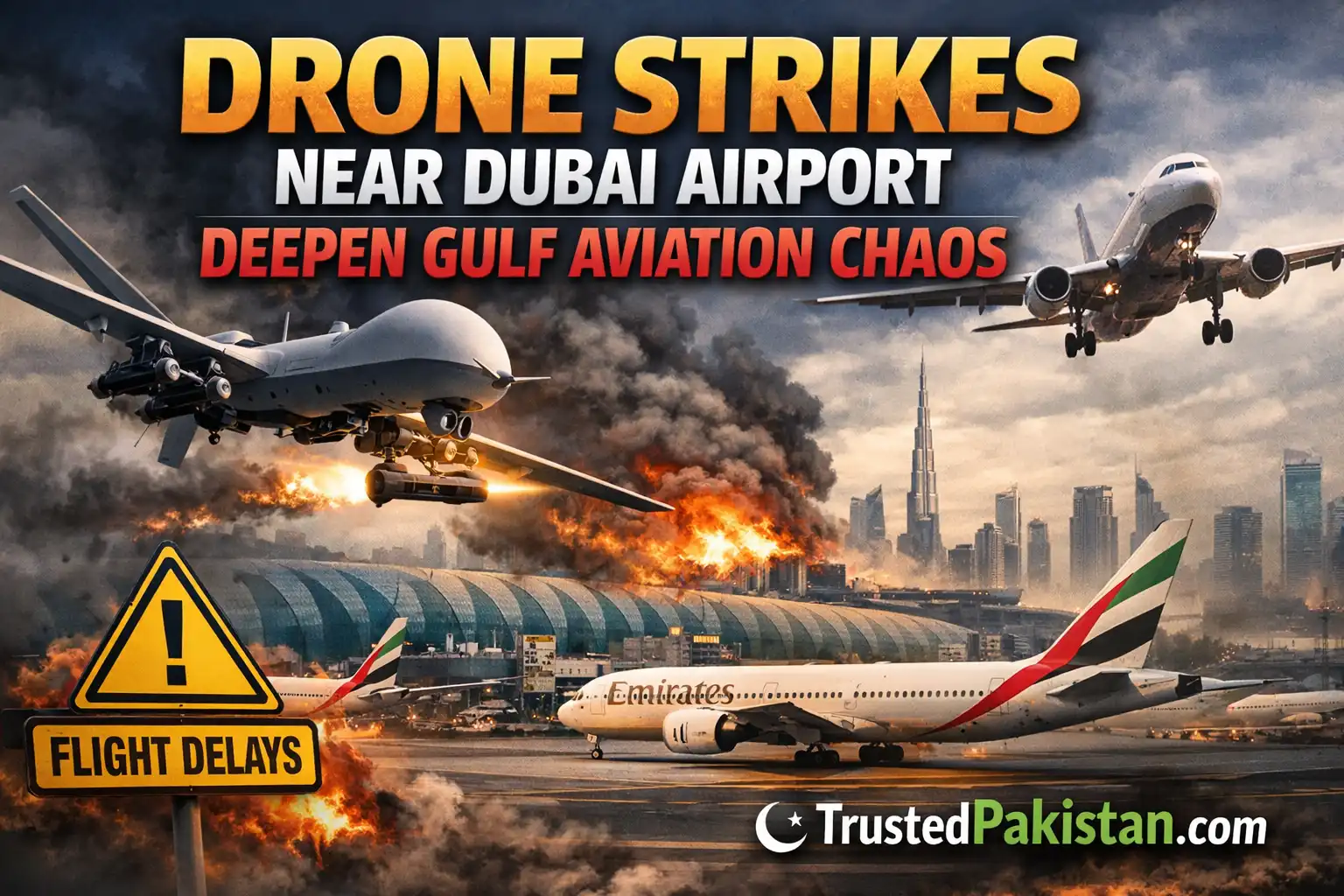
Drone Strikes Near Dubai Airport Deepen Gulf Aviation Chaos
A series of drone strikes near Dubai International Airport has intensified concerns over aviation safety in the Gulf region. The incident disrupted flight schedules, forced temporary airspace restrictions, and raised alarms among aviation authorities, airlines, and passengers. Dubai, one of the world’s busiest international travel hubs, depends heavily on stable airspace operations. Any disruption near its airport can quickly ripple across global travel networks. The recent strikes highlight growing security challenges in the region and the increasing use of drone technology in conflict-related incidents.
The Incident Near Dubai Airport
Reports indicate that several drones were detected flying dangerously close to restricted airspace surrounding Dubai International Airport. Authorities quickly activated emergency protocols after air defense systems identified the potential threat. Although the drones did not directly strike airport infrastructure, their proximity forced officials to temporarily suspend several incoming and outgoing flights as a precaution.
Air traffic controllers redirected multiple aircraft to alternative airports while others were delayed until the area was deemed safe. The brief closure of airspace created immediate congestion in nearby flight corridors. While airport authorities managed to restore operations within hours, the disruption was significant enough to affect hundreds of passengers and several international airlines.
Immediate Impact on Aviation
Dubai International Airport serves as a major connection point between Europe, Asia, and Africa. Even a short interruption can cause widespread flight delays across continents. Airlines reported delayed departures, rerouted flights, and missed connections as a direct result of the security scare.
Passengers experienced long waiting times at terminals, and airline customer service teams were overwhelmed by requests for rebooking and compensation. Cargo operations were also temporarily halted, affecting shipments passing through the Gulf’s major logistics hub.
The aviation industry is particularly sensitive to security threats, and incidents involving drones have become an increasing concern globally. Drones are relatively inexpensive and accessible, making them difficult to regulate and monitor, especially near busy airports.
Rising Drone Threats in the Region
Drone-related incidents have increased in several conflict-affected regions over the past decade. In the Gulf, geopolitical tensions and ongoing conflicts have made critical infrastructure—such as airports, oil facilities, and ports—potential targets.
Security experts warn that drones can easily bypass traditional defense systems due to their small size and low flight altitude. Even when they do not carry weapons, drones can cause major disruptions by forcing airspace closures.
Authorities across the Gulf have been investing in advanced anti-drone technologies, including radar detection systems, electronic jamming tools, and specialized security units trained to neutralize unmanned aerial vehicles. However, the rapid evolution of drone technology continues to challenge these defenses.
Economic Consequences
The Gulf region relies heavily on aviation and tourism. Dubai, in particular, has built its economy around global connectivity, hosting millions of international travelers every year. Any aviation disruption can have economic consequences beyond the airport itself.




Airlines may face increased operational costs due to rerouting flights and compensating passengers. Tourism businesses—including hotels, tour operators, and transport services—can also feel the effects of flight disruptions.
Furthermore, repeated security incidents could influence traveler confidence. International passengers often choose transit hubs based on reliability and safety, and ongoing instability in regional airspace may push airlines and travelers to reconsider routes.
Government and Security Response
Following the drone scare, aviation authorities in the United Arab Emirates launched an investigation to determine the origin of the drones and assess whether the incident was intentional or accidental. Officials also emphasized that airport safety remains their top priority.
The UAE has already implemented strict regulations on recreational and commercial drone use. Operators must obtain licenses and follow designated flight zones. Authorities may now consider tightening these rules further, particularly near sensitive infrastructure like airports.
Regional cooperation may also become more important. Since airspace in the Gulf is closely interconnected, security measures often require coordination between neighboring countries to effectively monitor potential threats.
TAP FOR MORE NEWS HERE
Future of Aviation Security
The incident near Dubai Airport underscores a growing challenge for modern aviation: balancing technological progress with safety. While drones offer valuable benefits in fields such as logistics, photography, and infrastructure monitoring, they also introduce new risks.
Airports around the world are investing in advanced monitoring systems capable of detecting unauthorized drones in real time. Artificial intelligence and improved radar systems are increasingly used to identify suspicious aerial activity before it reaches restricted zones.
Experts believe that stronger international regulations on drone manufacturing, registration, and tracking may also become necessary to prevent misuse.
Conclusion
The drone strikes near Dubai International Airport serve as a reminder of how vulnerable modern aviation systems can be to emerging technologies. Although authorities successfully managed the immediate threat, the incident exposed ongoing security challenges facing one of the world’s most important travel hubs.
As drone technology continues to spread, governments and aviation authorities must strengthen defenses, update regulations, and improve international cooperation. Ensuring safe skies will remain a priority not only for the Gulf region but for the global aviation industry as a whole.
