


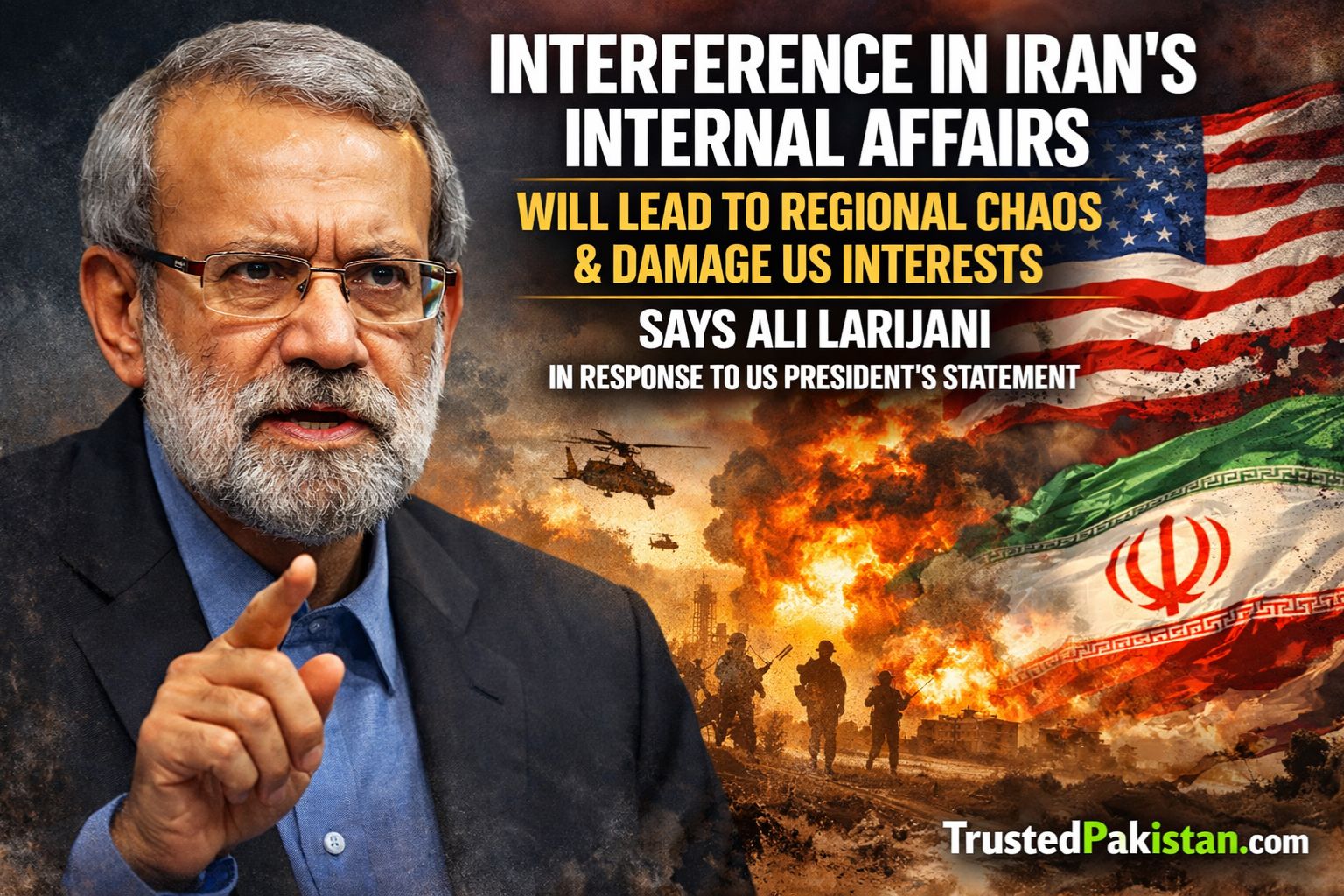
Interference in Iran’s Internal Affairs Will Lead to Regional Chaos and Damage US Interests | Says Ali Larijani in Response to US President’s Statement
Tehran Senior Iranian political figure and former parliament speaker Ali Larijani has strongly criticized recent remarks made by the US president, warning that any interference in Iran’s internal affairs would trigger widespread instability in the Middle East and severely damage American interests across the region.
Context of the Statement
Ali Larijani’s response came after the US president made comments regarding Iran’s internal political and security situation. Although the US administration has often framed such remarks as support for democracy and human rights, Iranian officials have repeatedly described them as direct interference in the country’s sovereignty.
The latest comments have further escalated tensions between Tehran and Washington at a time when relations between the two countries remain highly strained due to sanctions, regional conflicts, and stalled diplomatic engagements.
Strong Reaction from Tehran
In a strongly worded statement, Larijani rejected the US president’s remarks, calling them irresponsible and dangerous. He said that Iran is a sovereign nation with established political institutions and does not accept instructions or pressure from foreign powers.
“Any interference in Iran’s internal affairs will not only fail but will also lead to disorder and instability throughout the region,” Larijani warned. He added that such actions would ultimately result in the destruction of American political, economic, and security interests in the Middle East.
Warning Based on Past Experience
Larijani referred to previous US interventions in the region, including Iraq, Afghanistan, and Syria, saying these policies had caused long-term instability, violence, and humanitarian crises. He argued that instead of achieving peace or security, American involvement had left behind weakened states and ongoing conflicts.
“The United States should reflect on the consequences of its past actions,” he said, adding that repeating failed strategies would only deepen regional chaos.
Iran’s Stance on Sovereignty and National Unity
The Iranian leader emphasized that Iran’s internal matters are decided by its own people through national institutions and constitutional processes. He stressed that foreign pressure has historically strengthened Iran’s internal unity rather than weakening it.


According to Larijani, threats, sanctions, and hostile rhetoric have failed to change Iran’s political direction and have instead reinforced public resistance to external interference.
Message to the United States
Larijani warned Washington that any attempt to destabilize Iran would have serious consequences beyond the country’s borders. He said the Middle East is already facing multiple security challenges, and reckless statements or actions could ignite new crises.
He also noted that Iran possesses the political influence and strategic capabilities to defend its interests and respond to any hostile moves in a calculated manner.
Regional and International Implications
Political analysts believe Larijani’s remarks reflect broader concerns within Iran’s leadership about growing pressure from the United States. Experts warn that escalating rhetoric from both sides could further complicate regional diplomacy and increase the risk of confrontation.
Observers say the Middle East remains vulnerable to instability, and any sharp escalation between Iran and the US could impact energy markets, regional alliances, and ongoing conflicts in neighboring countries.
Calls for Diplomacy
Despite his strong language, Larijani indicated that Iran favors dialogue based on mutual respect and non-interference. He said that sustainable regional stability can only be achieved through cooperation rather than coercion.
International analysts have echoed calls for restraint, urging both sides to avoid inflammatory rhetoric and return to diplomatic channels to manage differences and prevent further escalation.
Conclusion
Ali Larijani’s response to the US president’s statement highlights Iran’s firm opposition to foreign intervention and underscores its warning that interference could have far-reaching consequences. As tensions persist, the situation remains closely watched by regional and global stakeholders, with many emphasizing the need for dialogue to avoid further instability in the Middle East.
