


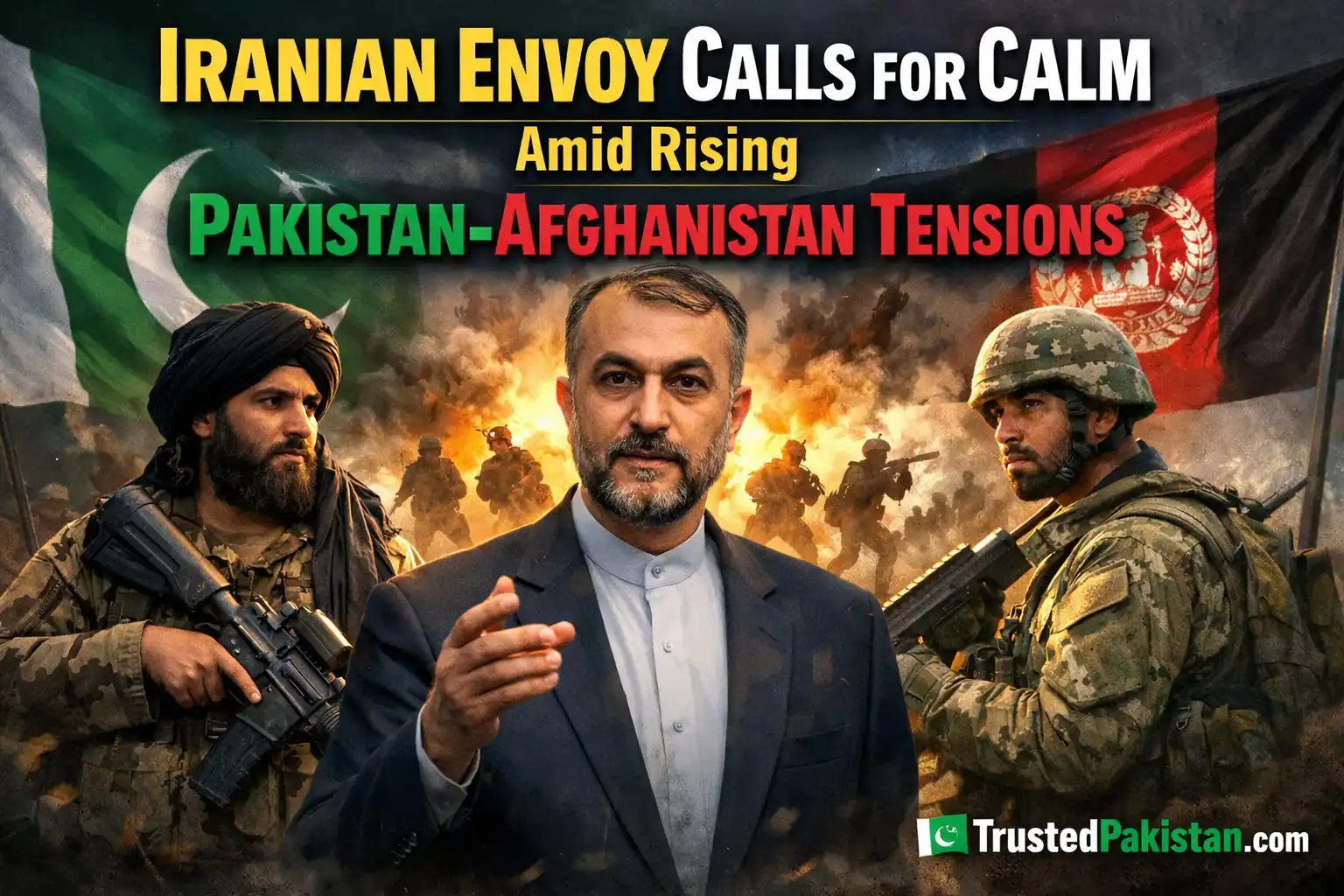
Iranian Envoy Calls for Calm Amid Rising Pakistan Afghanistan Tensions
Iranian envoy calls for calm amid rising Pakistan-Afghanistan tensions as diplomatic uncertainty grips the region. The statement comes at a critical moment when border security incidents, political mistrust, and militant activity have increased friction between Islamabad and Kabul. Iran, sharing borders with both countries, has stepped forward urging restraint, dialogue, and responsible engagement.
The Iranian envoy emphasized that continued escalation could destabilize not only Pakistan and Afghanistan but the broader South Asian and Middle Eastern regions. Stressing diplomacy over confrontation, the envoy called for structured negotiations and confidence-building measures to prevent further deterioration.
Background of Pakistan-Afghanistan Border Strains
Tensions between Pakistan and Afghanistan are not new. The two countries have long disputed border management along the Durand Line. Recent months have witnessed cross-border shelling, accusations of harboring militant groups, and rising nationalist rhetoric from both sides.
Security officials in Pakistan claim that militant networks operate from Afghan territory, launching attacks inside Pakistan. Meanwhile, Afghan authorities have rejected these allegations, countering that border violations and unilateral actions fuel instability.
In this volatile environment, the fact that the Iranian envoy calls for calm amid rising Pakistan-Afghanistan tensions highlights the seriousness of the situation. Tehran’s involvement signals growing regional concern over potential spillover effects.
Diplomatic Efforts to Prevent Escalation
The Iranian envoy’s message focused on immediate de-escalation through diplomatic channels. Iran has offered to facilitate dialogue, positioning itself as a neutral mediator capable of easing mistrust.
Tehran’s foreign policy strategy often prioritizes regional dialogue mechanisms. According to reports by Al Jazeera, diplomatic backchannels remain active between Islamabad and Kabul, though public rhetoric has intensified.
By reiterating that the Iranian envoy calls for calm amid rising Pakistan-Afghanistan tensions, Iranian officials aim to reduce inflammatory statements and encourage constructive engagement. Iran’s call includes proposals such as:
- Establishing joint border monitoring committees
- Intelligence-sharing agreements
- Coordinated counter-terrorism frameworks
- Regular diplomatic summits
Such steps could help rebuild confidence and prevent miscalculation.
Regional Security and Strategic Concerns
The broader geopolitical context makes this situation more sensitive. Pakistan plays a crucial role in regional counterterrorism efforts, while Afghanistan remains in a fragile political and economic state.
Iran’s security concerns are directly linked to stability in Afghanistan. Drug trafficking, refugee flows, and extremist movements all affect Iranian border provinces. Therefore, when the Iranian envoy calls for calm amid rising Pakistan-Afghanistan tensions, it reflects Tehran’s own national security priorities.
China, Russia, and Central Asian states are also monitoring developments closely. Any escalation could disrupt trade corridors, including projects linked to regional connectivity initiatives.
Economic and Humanitarian Implications
Beyond military and political dimensions, the economic consequences of rising tensions could be severe. Pakistan and Afghanistan share cross-border trade routes vital for local economies. Border closures disrupt supply chains, affect small businesses, and increase unemployment in already vulnerable regions.


Humanitarian concerns are equally pressing. Afghanistan continues to face economic hardship, and any disruption in trade or aid corridors could worsen food insecurity. Refugee movements toward neighboring countries, including Iran and Pakistan, may increase if violence escalates.
This context further explains why the Iranian envoy calls for calm amid rising Pakistan-Afghanistan tensions, warning that ordinary citizens would suffer the most from prolonged instability.
International Response and Global Stakes
The global community has expressed cautious concern. While major powers have avoided direct involvement, they have encouraged diplomatic engagement.
Iran’s proactive statement places it among the first regional actors to publicly advocate structured de-escalation. Analysts suggest that Tehran’s diplomatic outreach could help prevent the situation from spiraling into sustained confrontation.
The Iranian envoy calls for calm amid rising Pakistan-Afghanistan tensions not only as a political statement but as a strategic warning. Escalation could:
- Undermine counterterrorism operations
- Disrupt regional trade corridors
- Increase refugee flows
- Create opportunities for extremist exploitation
In this context, diplomatic restraint becomes a necessity rather than an option.
What Comes Next for Regional Stability
Moving forward, sustained diplomatic engagement will be essential. Confidence-building measures must translate from statements into actionable agreements.
Pakistan and Afghanistan may need third-party facilitation to maintain dialogue momentum. Iran’s offer of mediation could serve as a stabilizing channel, provided both sides demonstrate willingness to compromise.
The repetition of the message that the Iranian envoy calls for calm amid rising Pakistan-Afghanistan tensions underscores urgency. Diplomatic language alone will not suffice unless followed by:
- Transparent military communication channels
- Reduced border troop movements
- Public messaging that lowers nationalist rhetoric
- Renewed counterterrorism cooperation
Failure to act decisively could lead to unintended escalation.
The Role of Regional Mediation
Regional diplomacy may define the next phase of Pakistan-Afghanistan relations. Iran’s involvement indicates a shift toward multilateral stabilization efforts rather than isolated bilateral disputes.
If successful, mediation could create a new model of regional conflict management involving neighboring states. If unsuccessful, tensions may persist, leaving the region vulnerable to prolonged uncertainty.
Ultimately, stability between Pakistan and Afghanistan is essential for broader regional peace. Continued emphasis that the Iranian envoy calls for calm amid rising Pakistan-Afghanistan tensions reflects the pressing need for strategic patience, diplomatic maturity, and cooperative security mechanisms.
