


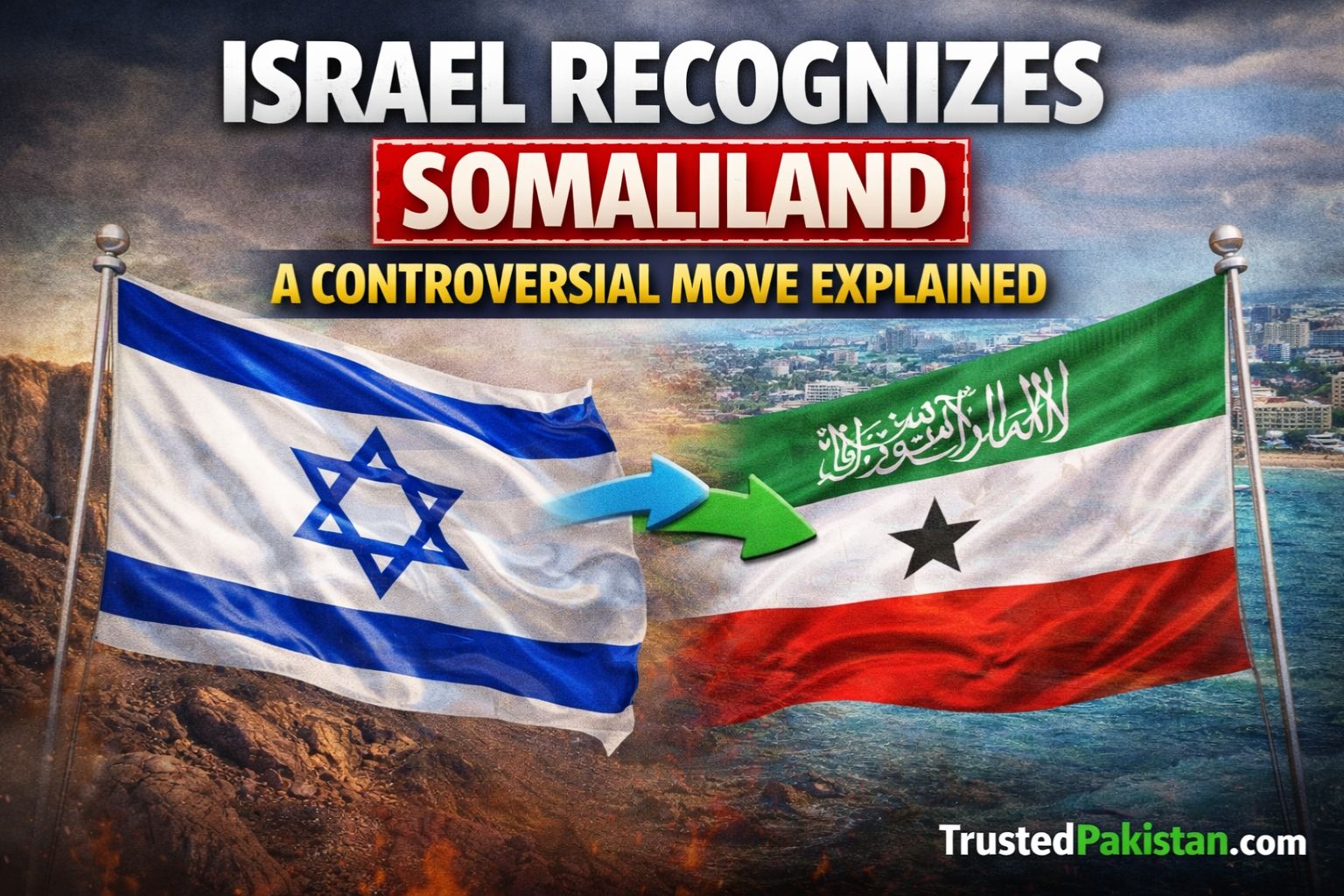
Israel Recognizes Somaliland | A Controversial Move Explained
Israel Recognizes Somaliland in a bold and highly controversial diplomatic move that has triggered anger across many Muslim countries and reignited debate over sovereignty, regional stability, and international law. The announcement has pushed the Horn of Africa back into the global spotlight, largely due to Somaliland’s strategic position near the Gulf of Aden, one of the world’s most critical maritime trade routes.
This development goes far beyond symbolic diplomacy. It reflects shifting alliances, security calculations, and power struggles that could reshape geopolitics in East Africa, the Red Sea, and the wider Middle East.
What Is Somaliland?
Somaliland is a self-declared state located in northwestern Somalia. It proclaimed independence in 1991, following the collapse of Somalia’s central government after years of civil war. Since then, Somaliland has operated as a de facto independent entity, complete with its own government, constitution, currency, military, and democratic elections.
Despite these state-like features, no member of the United Nations has formally recognized Somaliland as an independent country. Internationally, it is still considered part of Somalia. However, on the ground, Somaliland has enjoyed relative peace, political stability, and functioning institutions, in stark contrast to southern and central Somalia, which have struggled with militancy, political instability, and terrorism for decades.
This stability is a major reason why Israel Recognizes Somaliland as a potential strategic partner rather than merely a disputed region.
Why Israel Recognizes Somaliland
There are seven key reasons behind Israel’s controversial decision, each rooted in long-term strategic thinking rather than short-term diplomacy.
1. Strategic Location
Somaliland is situated near the Bab el-Mandeb Strait, a vital maritime chokepoint connecting the Red Sea with the Indian Ocean. Control or influence in this region allows monitoring of one of the world’s busiest shipping lanes.
2. Countering Regional Rivals
Israel aims to counter growing Iranian influence in the Red Sea and Horn of Africa, where Tehran has sought allies and footholds.
3. Security and Intelligence Cooperation
Somaliland offers valuable opportunities for intelligence gathering, maritime surveillance, and counterterrorism cooperation.
4. Diplomatic Expansion in Africa
Israel has been actively expanding its diplomatic footprint across Africa, seeking allies outside traditional Middle Eastern power structures.
5. Trade and Maritime Interests
The Gulf of Aden is critical for global shipping, energy supplies, and Israeli trade routes to Asia and Africa.
6. Potential Military Access
Access to ports, airstrips, or logistical facilities would significantly enhance Israel’s regional reach.
7. Political Signaling
By recognizing Somaliland, Israel sends a strong message to allies and adversaries about its willingness to take independent and assertive foreign policy decisions.
Strategic Importance of the Gulf of Aden
The Gulf of Aden connects the Arabian Sea with the Red Sea and serves as a gateway to the Suez Canal. Nearly 12% of global trade, including oil shipments, passes through this narrow corridor each year.



Any new military presence, diplomatic shift, or instability in this region can have far-reaching consequences, including:
- Rising oil prices
- Disruption of global supply chains
- Increased naval tensions
This is why Israel Recognizes Somaliland is being viewed by analysts as a high-stakes geopolitical gamble, not just a bilateral decision.
Reaction of Muslim Countries
Muslim-majority nations, particularly in the Arab and Islamic world, have reacted with strong criticism. Many governments and analysts view Israel’s move as:
- A violation of Somalia’s sovereignty
- A destabilizing precedent encouraging separatism
- An expansion of Israeli influence near sensitive Arab waterways
Countries such as Turkey, Egypt, and members of the Arab League have openly expressed concern, warning that the decision could escalate regional tensions.
TAP FOR MORE NEWS HERE
Somalia’s Official Position
The Somali federal government has categorically rejected Israel’s recognition of Somaliland. Officials in Mogadishu insist that Somaliland is an inseparable part of Somalia, regardless of its internal governance.
Somalia has warned that such recognition could:
- Encourage other separatist movements
- Undermine national unity
- Violate established principles of international law
The government has also urged the international community not to follow Israel’s example.
International Law & Global Response
Under international law, state recognition generally depends on four criteria:
- A defined territory
- A permanent population
- An effective government
- The capacity to engage in international relations
While Somaliland meets many of these conditions, the absence of Somalia’s consent remains the most significant legal and diplomatic barrier. As a result, most global powers have so far remained silent, cautious, or non-committal.
Future Implications
If additional countries follow Israel’s lead:
- Somaliland could gain gradual international legitimacy
- Somalia’s territorial integrity may weaken
- Red Sea and Horn of Africa geopolitics could change dramatically
If Israel remains isolated on this issue, however, the move may stay largely symbolic, with limited practical impact.
Conclusion
Israel Recognizes Somaliland in a decision that is reshaping debates around sovereignty, security, and regional power in the Horn of Africa. While Somaliland views the recognition as a long-awaited breakthrough, many Muslim countries fear political manipulation and regional destabilization.
Whether this move becomes a historic turning point or remains a controversial diplomatic gesture will depend on how the international community responds in the months ahead.
