


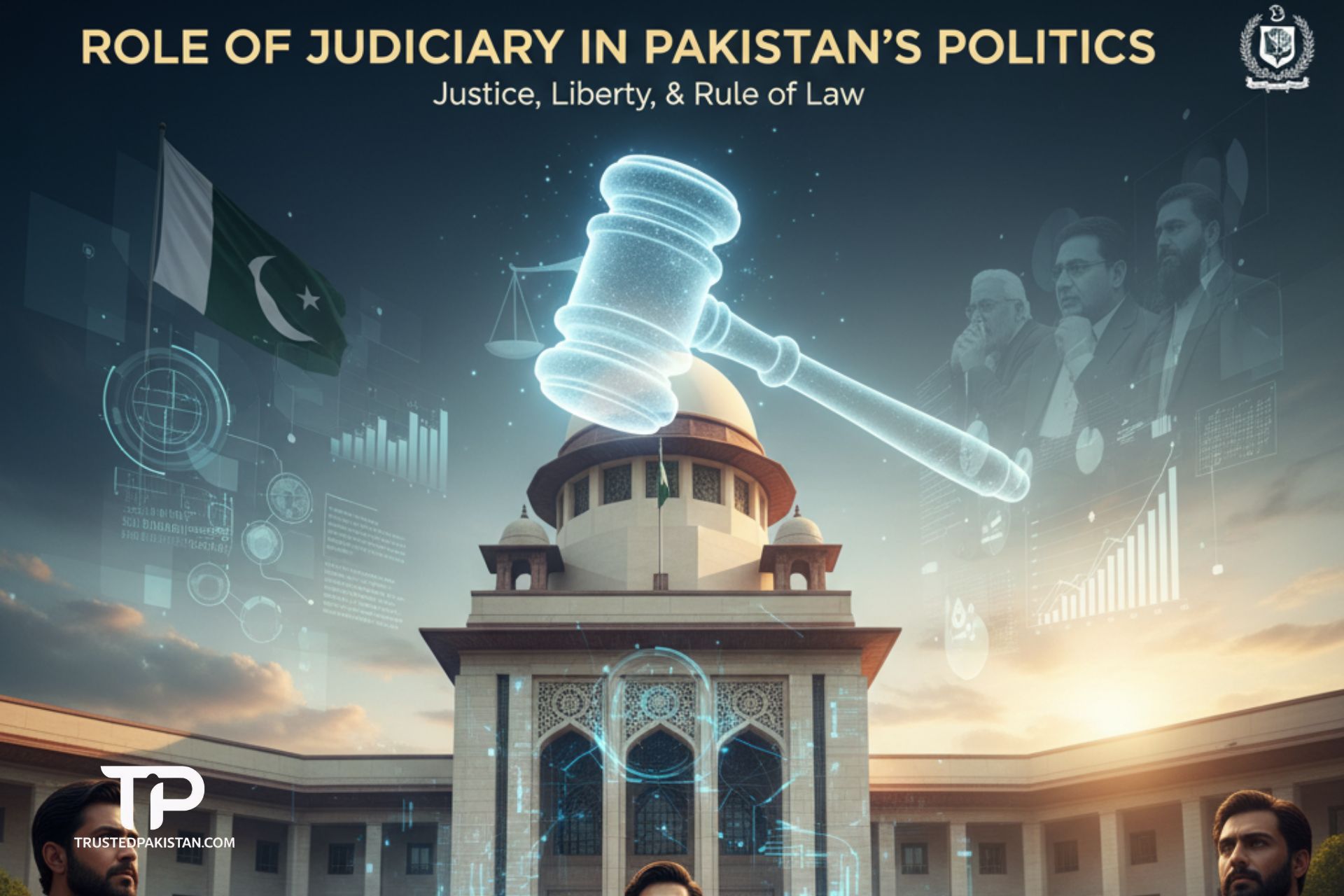
Role of Judiciary in Pakistan’s Politics
Politics in Pakistan has never been free from judicial influence. From validating military takeovers to striking down unconstitutional moves, the judiciary has shaped the country’s political journey in remarkable ways. If you’ve ever wondered how deep the judiciary’s role in Pakistan’s politics goes, you’re not alone.
As someone TrustedPakistan.com (Islamabad) who has followed Pakistani politics closely for years, I’ve seen how decisions of the Supreme Court can change the entire political landscape overnight. This article explains the constitutional role of the judiciary, highlights landmark decisions, and examines the challenges of judicial activism and military interventions.
Judiciary’s Constitutional Role
At its core, Pakistan’s judiciary is tasked with upholding the Constitution. The Supreme Court, High Courts, and lower judiciary ensure that no law or executive order violates constitutional principles.
- The judiciary is the guardian of fundamental rights (Article 199 and 184(3) of the Constitution).
- It interprets the law and acts as a check on the executive and legislative branches.
- The Supreme Court of Pakistan has the power of judicial review, meaning it can declare any law or action void if it contradicts the Constitution.
Without this watchdog role, the balance between democracy, governance, and rule of law would collapse.
Landmark Supreme Court Decisions
The judiciary’s influence in Pakistan’s politics is best understood through landmark judgments.
Notable Cases
- Maulvi Tamizuddin Case (1954): The Federal Court validated the Governor-General’s dissolution of the Constituent Assembly, setting a precedent for executive dominance.
- Dosso Case (1958): The judiciary invoked Hans Kelsen’s theory of revolutionary legality to legitimize Ayub Khan’s military coup.
- Zulfikar Ali Bhutto Case (1979): Bhutto’s controversial death sentence raised serious questions about judicial independence.
- Nawaz Sharif’s Dismissals (1993 & 1999): The courts alternated between restoring and endorsing the dismissal of governments, showing inconsistency.
- Panama Papers Case (2017): Disqualified Nawaz Sharif as Prime Minister, proving how judicial decisions can directly change political leadership.
Each case reflects how Supreme Court politics has often tilted the scales of democracy.
Judiciary and Military Interventions
Pakistan’s history is full of military interventions, and unfortunately, the judiciary often provided legal cover to these coups.
- 1958: Validated Ayub Khan’s martial law.
- 1977: Endorsed General Zia-ul-Haq’s coup against Bhutto.
- 1999: Legalized General Pervez Musharraf’s takeover under the “doctrine of necessity.”
While courts later expressed regret over these decisions, the damage was already done. Critics argue that had the judiciary stood firm, Pakistan might have avoided repeated derailments of democracy.




Criticism of Judicial Activism
In recent decades, Pakistan’s judiciary has been accused of judicial activism—intervening in areas that many believe belong to the executive or legislature.
Common Criticisms
- Selective accountability: Political cases are often pursued more aggressively than non-political corruption cases.
- Overstepping authority: Courts sometimes make administrative decisions, like controlling sugar prices or appointing officials.
- Media influence: High-profile cases are heavily covered, creating perceptions of bias.
While judicial activism can protect democracy, excessive intervention risks politicizing the judiciary itself. IMO, it’s like walking on a tightrope—too much power either way can shake the entire democratic structure.
Future of Judiciary in Democratic Pakistan
The big question: What role should Pakistan’s judiciary play in the future?
Key Recommendations
- Strengthening independence: Judges must be free from political and military pressure.
- Institutional reforms: Transparent appointment processes for judges (through the Judicial Commission).
- Limiting judicial overreach: Focusing on constitutional issues instead of administrative matters.
- Public trust: Courts should prioritize consistency in verdicts to rebuild faith in the system.
If Pakistan’s judiciary sticks to its constitutional role, it can be a true guardian of democracy and justice. Otherwise, history may keep repeating itself.
FAQs
1. What is the role of judiciary in Pakistan?
The judiciary safeguards the Constitution, protects fundamental rights, and ensures no law or executive act violates constitutional principles.
2. Has the judiciary supported military rule in Pakistan?
Yes, in multiple cases, courts validated military coups under the “doctrine of necessity.” However, this approach has been widely criticized.
3. What is judicial activism in Pakistan?
Judicial activism refers to courts taking an active role in governance, sometimes beyond constitutional limits, often to protect public interest.
4. How does the judiciary affect democracy in Pakistan?
By interpreting the law and checking government actions, the judiciary can either strengthen democracy or weaken it through inconsistent decisions.
5. What is the future of judiciary in Pakistan’s politics?
If the judiciary remains independent and avoids political bias, it can strengthen democracy. Otherwise, it risks losing public trust.
