


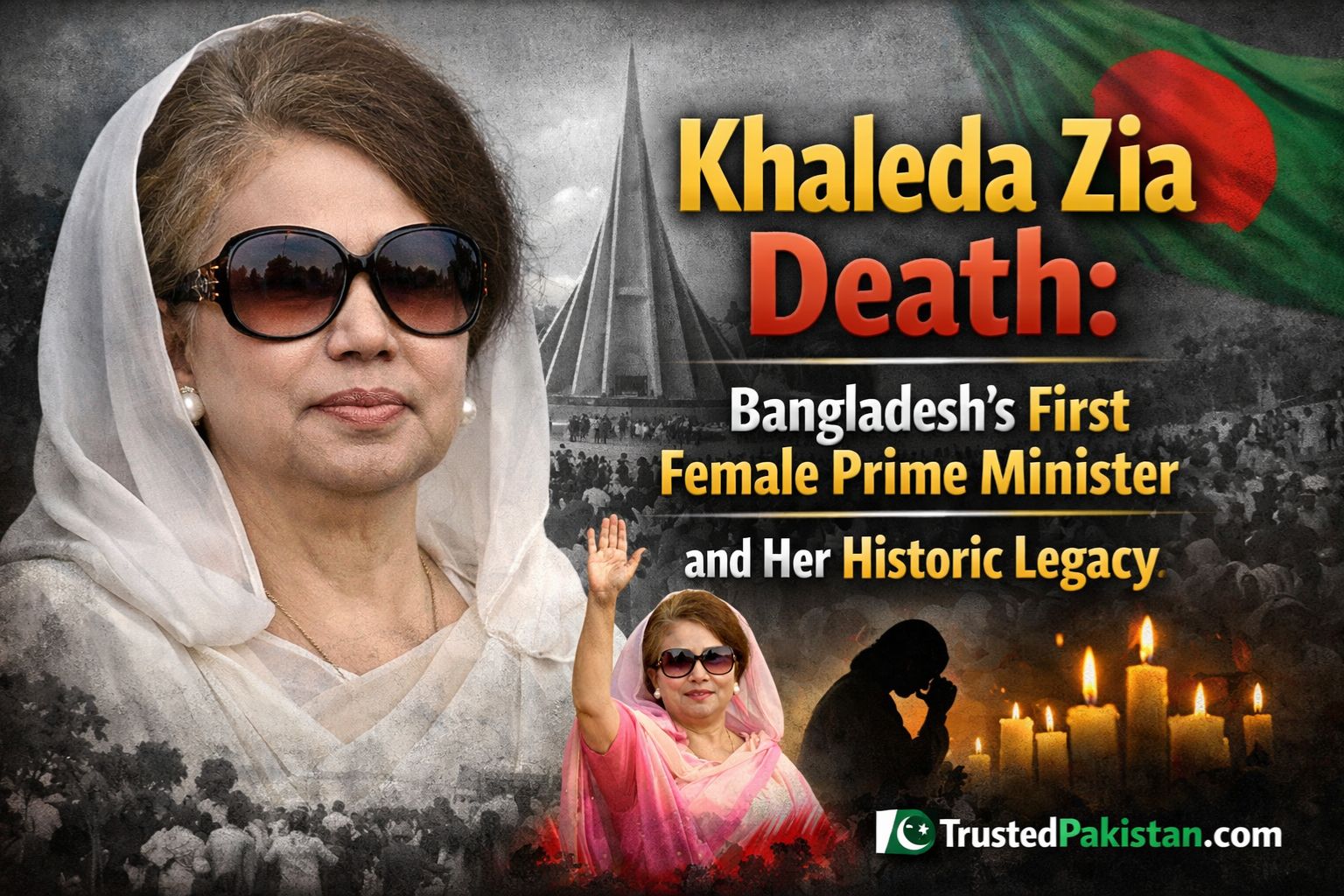
Khaleda Zia Death | Bangladesh’s First Female Prime Minister and Her Historic Legacy
Khaleda Zia Death has deeply saddened South Asia, marking the end of a powerful and historic political chapter in Bangladesh’s history. As the country’s first female prime minister, Khaleda Zia shaped national politics for decades and remained a significant figure beyond Bangladesh’s borders. In Pakistan, she was often regarded as a close friend due to her supportive stance on regional cooperation and diplomacy.
Her passing is not only the loss of a political leader but also the end of an era that defined democratic struggles, women’s leadership, and political rivalry in South Asia.
Who Was Khaleda Zia?
Khaleda Zia was a veteran Bangladeshi politician and the long-time chairperson of the Bangladesh Nationalist Party (BNP). She served as the Prime Minister of Bangladesh twice, from 1991 to 1996 and again from 2001 to 2006. Her leadership coincided with Bangladesh’s return to parliamentary democracy after years of military and authoritarian rule.
Known for her firm political stance and mass appeal, Khaleda Zia was one of the most influential leaders in Bangladesh’s modern history. Alongside Sheikh Hasina, she formed one half of the country’s most enduring political rivalry.
Khaleda Zia Death | Early Life and Political Rise
Khaleda Zia Death brings renewed attention to her extraordinary journey from a private citizen to a national leader. Born in 1945, Khaleda Zia lived a relatively quiet life until tragedy changed her destiny. The assassination of her husband, President Ziaur Rahman, in 1981 became the turning point of her life.
Following his death, she entered politics to preserve his legacy and protect the Bangladesh Nationalist Party. Despite having no prior political experience, she quickly gained public support and emerged as a strong opposition voice against military rule.
Her rise symbolized resilience. She transformed personal grief into political strength, mobilizing supporters across the country and proving that leadership was not limited by gender in a traditionally male-dominated society.
Becoming Bangladesh’s First Female Prime Minister
In 1991, Khaleda Zia made history by becoming Bangladesh’s first female prime minister through democratic elections. This achievement placed her among the world’s pioneering women leaders and inspired greater female participation in South Asian politics.
During her first term, she focused on:
- Restoring parliamentary democracy
- Strengthening democratic institutions
- Promoting economic reforms
- Improving foreign relations
Her leadership helped stabilize the political system at a crucial moment in Bangladesh’s development.




Khaleda Zia and Pakistan | A Strategic Friendship
Khaleda Zia was often referred to in Pakistani media as “Pakistan ki dost” (friend of Pakistan). She supported dialogue, mutual respect, and improved bilateral relations between Pakistan and Bangladesh.
At times of regional tension, her diplomatic tone emphasized cooperation rather than confrontation. This approach earned her recognition in Pakistan as a leader willing to move forward constructively in South Asian politics.
Political Challenges and Controversies
Despite her achievements, Khaleda Zia Death also revives discussion about the controversies she faced. Her long-standing rivalry with Sheikh Hasina dominated Bangladesh’s political landscape for decades. The alternation of power between the BNP and Awami League created deep political polarization in the country.
In later years, Khaleda Zia faced corruption charges and legal battles, which significantly affected her political career. Health issues further limited her public appearances, and she gradually withdrew from active politics.
Supporters viewed her legal troubles as politically motivated, while critics argued they reflected governance failures. Regardless of opinion, her influence on Bangladesh’s political narrative remained undeniable.
Legacy of Khaleda Zia
The legacy left after Khaleda Zia Death is complex, influential, and historic. Her contributions include:
- Opening doors for women in high-level politics
- Strengthening multi-party democracy
- Shaping Bangladesh’s modern political identity
- Encouraging voter participation during democratic transitions
Her leadership demonstrated that women could lead nations through political crises and institutional reform.
Global Reactions to Khaleda Zia Death
Following Khaleda Zia Death, condolences poured in from political leaders, parties, and international organizations. Global media outlets highlighted her role in shaping Bangladesh’s democracy and women’s leadership.
International observers recognized her as a key figure in South Asian politics whose influence extended beyond national borders.
Conclusion
Khaleda Zia Death marks the end of a defining political era in Bangladesh. As the nation’s first female prime minister, she challenged traditional norms, led through political upheaval, and left behind a legacy that will continue to influence South Asian politics for generations.
Her name will remain etched in history as a symbol of leadership, resilience, and political transformation — a leader who turned personal tragedy into national service and reshaped the political landscape of Bangladesh.
