


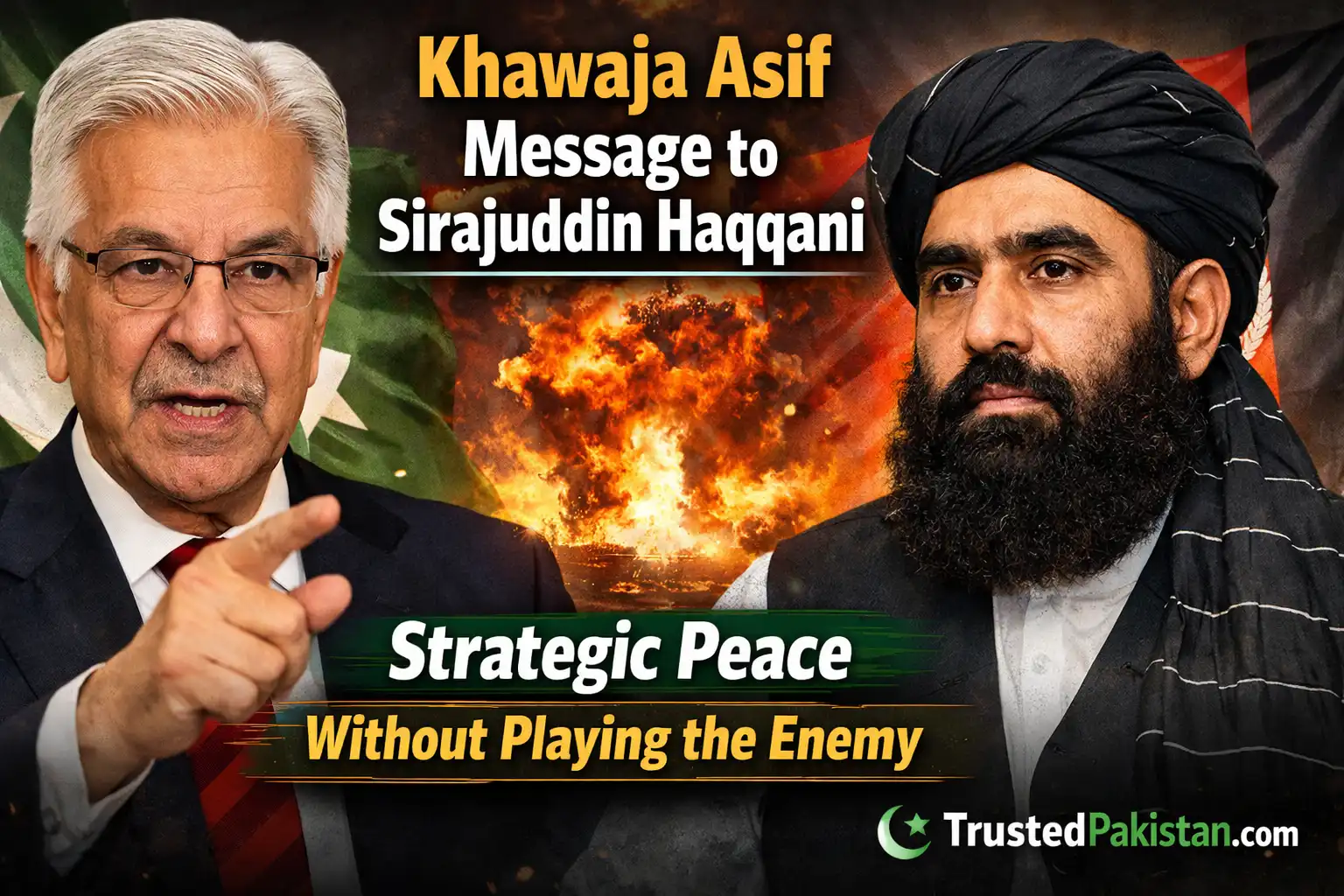
Khawaja Asif Message to Siraj Uddin Haqqani | Strategic Peace Without Playing the Enemy
Khawaja Asif Message to Sirajuddin Haqqani has sparked intense political and diplomatic discussion across South Asia. The statement, translated as “We can help settle our enemy, but we should not play the role of an enemy,” reflects a nuanced diplomatic position aimed at balancing national security with regional stability.
This message signals a broader strategy rather than a simple political remark. It touches on Pakistan’s evolving foreign policy approach toward Afghanistan and its internal security concerns.
Background of Khawaja Asif Message to Siraj Uddin Haqqani
Khawaja Asif Message to Sirajuddin Haqqani emerged during heightened tensions regarding cross-border security and militant activities. Sirajuddin Haqqani, a key Afghan Taliban leader and interior minister of Afghanistan, remains a significant figure in regional politics.
The core message suggests that while states may have differences, turning hostility into permanent enmity harms long-term stability. The statement advocates constructive engagement rather than confrontation.
This diplomatic tone reflects Pakistan’s need to maintain stability along its western border while protecting its national interests.
Political Context Behind the Statement
The political environment surrounding Khawaja Asif Message to Sirajuddin Haqqani involves multiple layers:
- Border security concerns
- Counterterrorism cooperation
- Diplomatic recognition challenges
- Economic interdependence
Pakistan faces internal security pressures and international scrutiny regarding its Afghan policy. Therefore, the message appears to be a strategic balancing act.
Rather than escalating rhetoric, Khawaja Asif Message to Sirajuddin Haqqani promotes dialogue over direct confrontation.
7 Strategic Facts About Khawaja Asif Message to Sirajuddin Haqqani
1. Emphasis on Diplomacy Over Conflict
Khawaja Asif Message to Sirajuddin Haqqani underlines engagement instead of hostility. The approach seeks cooperation in security matters rather than aggressive retaliation.
2. Recognition of Regional Interdependence
Pakistan and Afghanistan share deep historical, cultural, and economic ties. Ignoring these realities can destabilize both nations.
3. Counterterrorism Concerns
Security challenges remain central. The message subtly calls for action against militant groups without escalating public confrontation.
4. Strategic Communication
Political statements often serve diplomatic signaling. Khawaja Asif Message to Sirajuddin Haqqani appears designed to communicate firmness with restraint.
5. Domestic Audience Consideration
The message reassures citizens that national security remains a priority while avoiding unnecessary escalation.
6. International Diplomacy Angle
Global stakeholders closely monitor Pakistan-Afghanistan relations. A moderate tone helps maintain diplomatic credibility.
7. Strategic Stability Objective
Long-term regional peace depends on calculated engagement rather than reactive policy shifts. Khawaja Asif Message to Sirajuddin Haqqani reflects this long-term vision.
Regional Security Implications
Khawaja Asif Message to Sirajuddin Haqqani may influence border management strategies and intelligence coordination.
Pakistan’s western border has historically been volatile. Cooperation between Islamabad and Kabul is essential for counterterrorism effectiveness.
If both sides interpret the message positively, it could open doors for renewed coordination mechanisms.



Diplomatic Significance for Pakistan-Afghanistan Relations
Diplomacy between Pakistan and Afghanistan has fluctuated over decades. The statement reinforces a policy of pragmatic engagement.
By saying that one should not “play the role of an enemy,” Khawaja Asif Message to Sirajuddin Haqqani promotes avoiding escalatory narratives.
Such diplomatic signaling is crucial in maintaining dialogue channels.
Domestic Political Impact
Domestically, Khawaja Asif Message to Sirajuddin Haqqani may resonate differently among political parties.
Some critics may perceive it as soft diplomacy, while supporters may view it as strategic maturity.
Public discourse often polarizes around foreign policy decisions. However, maintaining a balanced approach remains essential for sustainable governance.
Media and Public Reaction
Media coverage has amplified Khawaja Asif Message to Sirajuddin Haqqani, interpreting it through various lenses:
- Strategic diplomacy
- Security warning
- Political messaging
The framing often depends on editorial alignment and geopolitical perspectives.
Nevertheless, the statement’s core remains consistent: cooperation without surrendering national interests.
TAP FOR MORE NEWS HERE
Future Outlook and Regional Power Balance
Khawaja Asif Message to Sirajuddin Haqqani may shape upcoming diplomatic engagements between Islamabad and Kabul.
Future developments will likely depend on:
- Security cooperation progress
- Border stability improvements
- Economic coordination efforts
- International diplomatic recognition dynamics
The evolving regional power balance involving China, the United States, and neighboring states also plays a role.
If constructive engagement continues, Khawaja Asif Message to Sirajuddin Haqqani could mark a turning point toward pragmatic diplomacy in South Asia.
Emerging Geopolitical Shifts in South Asia
Beyond immediate diplomatic messaging, South Asia is entering a new geopolitical phase. Power realignments, economic corridors, and security alliances are reshaping regional dynamics.
Strategic communication like Khawaja Asif Message to Sirajuddin Haqqani demonstrates how political language can influence regional stability.
As diplomatic narratives evolve, balanced engagement, economic integration, and coordinated security frameworks will determine the region’s long-term trajectory.
Understanding these broader shifts helps contextualize why Khawaja Asif Message to Sirajuddin Haqqani carries significance beyond a single statement.
