


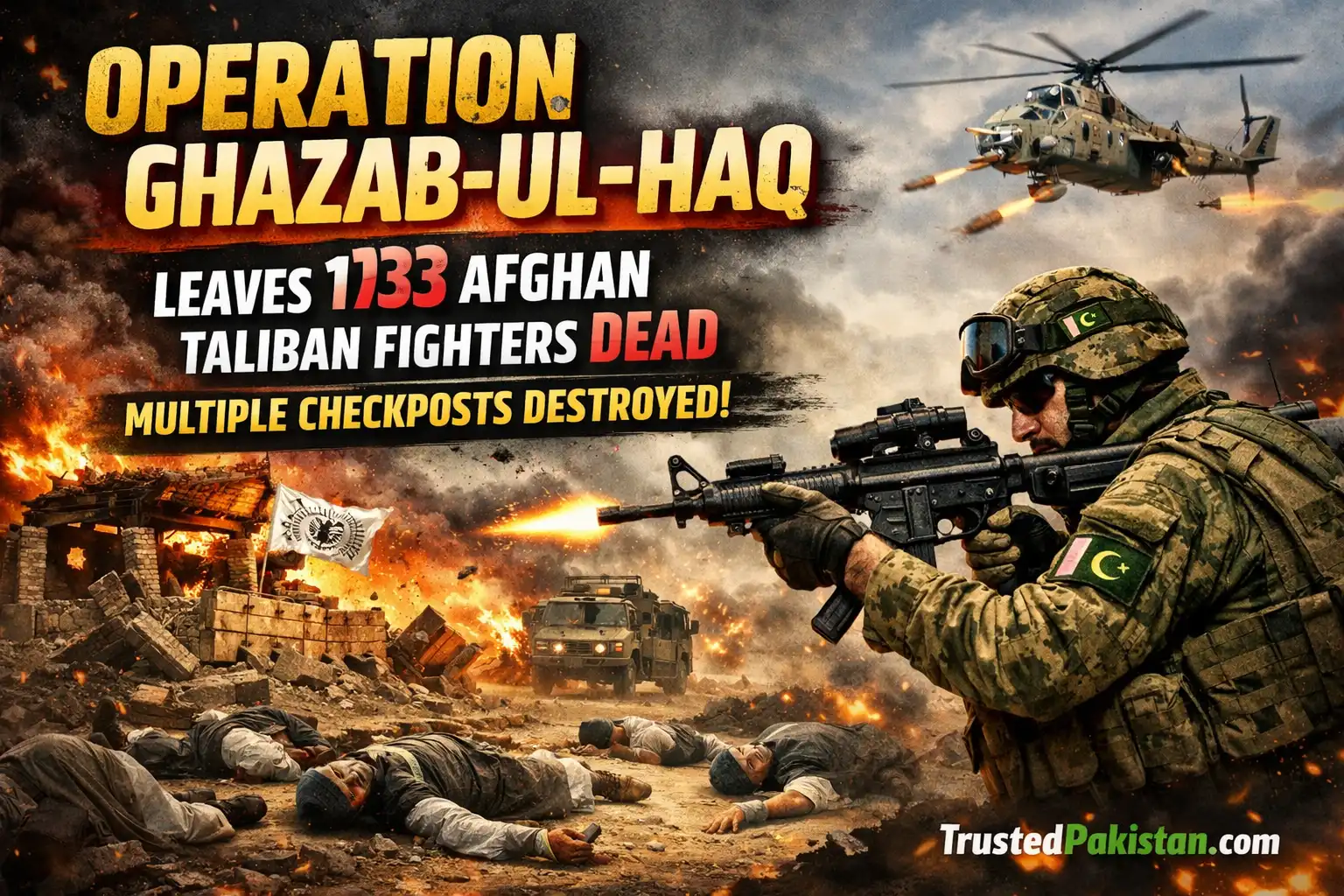
Operation Ghazab-ul-Haq Leaves 133 Afghan Taliban Fighters Dead Multiple Checkposts Destroyed
Tensions along the Pakistan–Afghanistan border have escalated sharply following a major military operation reportedly conducted by Pakistani security forces under the name “Operation Ghazab-ul-Haq.” According to official statements, the operation resulted in the deaths of 133 Afghan Taliban fighters and the destruction of several militant checkposts allegedly used for cross-border attacks. The development has further strained relations between the two neighboring countries, raising concerns about regional stability and security.
Background of Border Tensions
The Pak-Afghan border, commonly referred to as the Durand Line, has long been a source of political and military friction. Spanning approximately 2,640 kilometers, the border separates Pakistan’s Khyber Pakhtunkhwa and Balochistan provinces from Afghanistan. For decades, both sides have faced challenges related to cross-border militancy, smuggling, and unauthorized movement.
In recent months, Pakistani authorities have repeatedly accused militant groups operating from Afghan territory of launching attacks inside Pakistan. Islamabad claims that these groups, including factions aligned with the Tehrik-i-Taliban Pakistan (TTP), have found safe havens across the border. Afghan officials, however, have often denied such allegations, maintaining that they do not allow their soil to be used against any other country.
Launch of Operation “Ghazab-ul-Haq”
Operation “Ghazab-ul-Haq,” translated as “Wrath for the Truth,” was reportedly initiated following a series of deadly attacks on Pakistani security forces near border districts. According to military sources, the operation targeted suspected militant hideouts and fortified checkposts believed to facilitate infiltration and armed assaults.
Security officials stated that the operation was conducted after receiving actionable intelligence about imminent threats. Air and ground forces were reportedly involved in coordinated strikes aimed at dismantling what authorities described as “terror infrastructure” close to the border region.
Pakistani officials claim that 133 Afghan Taliban fighters were killed during the operation, and multiple militant checkposts were destroyed. The military emphasized that the action was defensive in nature, aimed at protecting national sovereignty and preventing further loss of life among civilians and security personnel.
Destruction of Militant Infrastructure
One of the key objectives of the operation was the elimination of fortified positions allegedly used by militants to stage cross-border incursions. Military briefings indicated that several observation posts and logistical hubs were targeted and neutralized.
The destruction of these positions, officials argue, has significantly disrupted militant supply lines and operational capabilities in the immediate border area. However, independent verification of casualty figures and the extent of infrastructure damage remains limited due to restricted access to the conflict zone.
Diplomatic Repercussions
The operation has triggered diplomatic reactions from both sides. Afghan authorities reportedly expressed concern over what they described as cross-border military action, calling for restraint and dialogue. In contrast, Pakistani officials defended the operation as a necessary counterterrorism measure.
Analysts suggest that the incident could further complicate already fragile relations between Islamabad and Kabul. While both countries have repeatedly pledged cooperation in combating terrorism, mistrust persists. Cross-border accusations and retaliatory measures have historically undermined joint security efforts.



International observers have also voiced concern about the potential for escalation. The region’s complex security dynamics—coupled with economic challenges and political uncertainty—make sustained stability difficult to achieve without coordinated diplomatic engagement.
Security and Humanitarian Concerns
Beyond military and diplomatic dimensions, the renewed tensions have humanitarian implications. Border communities on both sides often bear the brunt of escalations, facing displacement, economic disruption, and restricted movement.
Local residents in affected areas have reported heightened security checks and temporary closures of border crossings, impacting trade and daily life. The Pak-Afghan border serves as a critical transit point for commerce and humanitarian aid, and prolonged instability could exacerbate economic hardships in already vulnerable regions.
Security experts warn that continued confrontation could embolden extremist elements seeking to exploit instability. They argue that sustainable peace requires not only military measures but also political dialogue, intelligence sharing, and economic cooperation.
Regional Implications
The broader regional context adds another layer of complexity. Pakistan and Afghanistan are strategically significant countries in South and Central Asia, and instability along their shared border can have ripple effects beyond bilateral relations.
Neighboring states and international stakeholders closely monitor developments, particularly given concerns about transnational militancy. Stability along the Durand Line is viewed as essential for regional connectivity projects and counterterrorism cooperation.
Some analysts believe that Operation “Ghazab-ul-Haq” signals a more assertive security posture by Pakistan in response to rising internal security threats. Others caution that military actions alone may not resolve deeply rooted political and ideological challenges.
The Path Forward
As tensions remain high, calls for diplomatic engagement are growing. Experts emphasize the importance of bilateral communication channels to prevent misunderstandings and reduce the risk of further escalation. Confidence-building measures, joint border monitoring mechanisms, and transparent investigations into cross-border incidents could help ease tensions.
While Operation “Ghazab-ul-Haq” represents a significant military development, the long-term trajectory of Pak-Afghan relations will likely depend on sustained dialogue and cooperative security frameworks. Without mutual trust and coordinated efforts, sporadic clashes could continue to destabilize the border region.
In a region marked by decades of conflict, the latest escalation serves as a reminder of the fragile balance between security imperatives and diplomatic solutions. Whether this operation leads to greater stability or deeper confrontation remains to be seen, but its impact on regional dynamics is already evident.
