


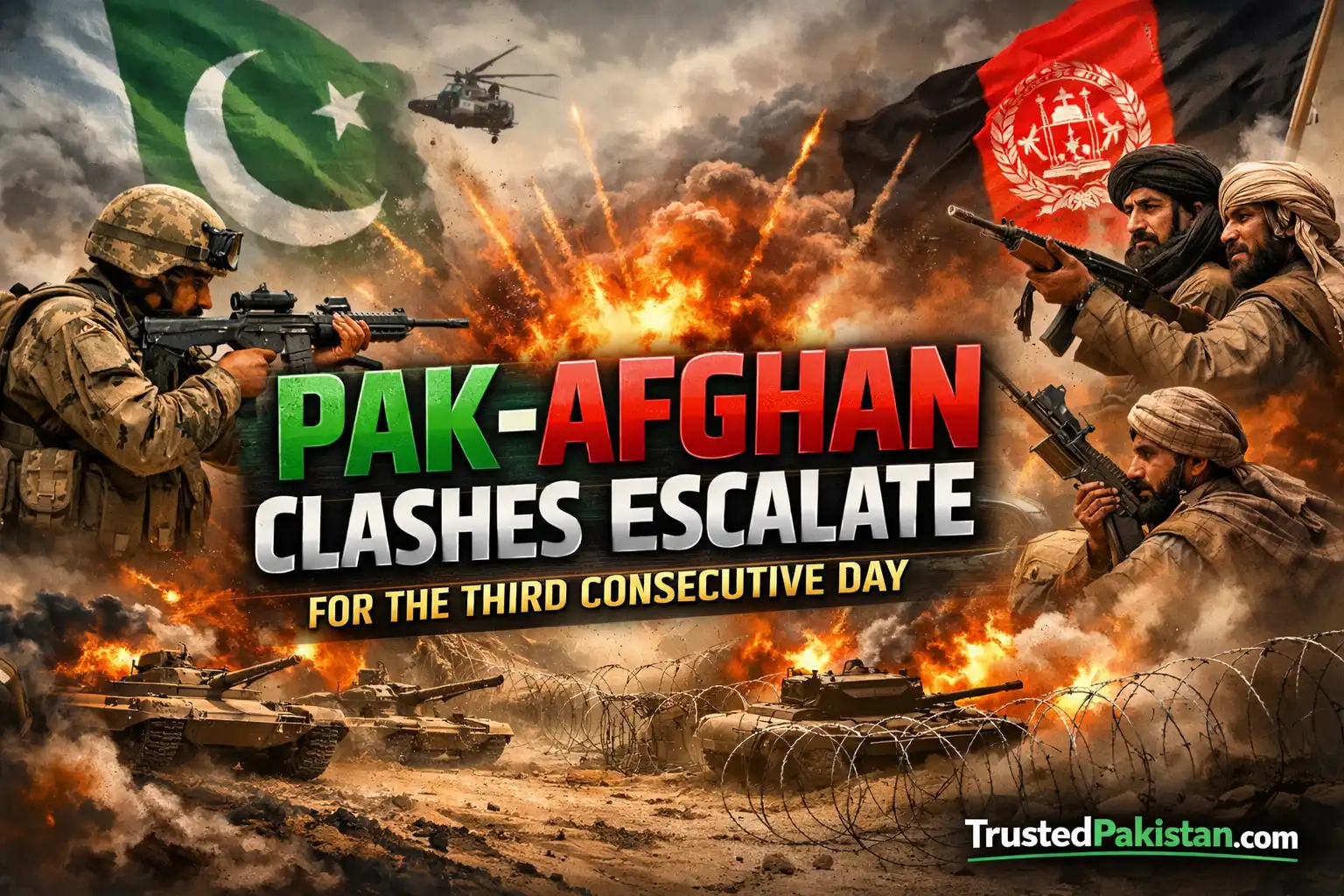
Pak Afghan Clashes Escalate for the Third Consecutive Day
Pak-Afghan clashes intensified on the border as fighting entered its third consecutive day, raising serious concerns about regional stability and civilian safety. Security officials from both sides confirmed heavy exchanges of fire across multiple checkpoints, with artillery shelling and cross-border accusations further escalating tensions.
The latest round of Pak-Afghan clashes has reportedly resulted in casualties among security personnel and civilians, though exact numbers remain disputed. Border villages have experienced panic, forcing families to flee toward safer areas.
The continuation of Pak-Afghan clashes signals a dangerous shift from isolated skirmishes to sustained confrontation, increasing fears of prolonged instability in the region.
Background of Pak-Afghan Clashes
Pak-Afghan clashes are not a new phenomenon. The border between Pakistan and Afghanistan, particularly along the Durand Line, has long been a source of political and military friction. Disagreements over border fencing, cross-border militant movement, and territorial claims have repeatedly fueled tension.
In recent years, Pak-Afghan clashes have erupted periodically due to disputes over border infrastructure projects and accusations of harboring armed groups. Both governments have accused each other of failing to control militant elements operating near the frontier.
For deeper regional security analysis, readers can explore our internal assessment on South Asia’s evolving security landscape here:
/south-asia-security-analysis
Key Flashpoints Along the Border
Several major crossing points have emerged as flashpoints in the current Pak-Afghan clashes. Reports indicate that heavy exchanges occurred near key border terminals where trade and civilian movement are typically concentrated.
The Torkham and Spin Boldak crossings have historically witnessed episodes of Pak-Afghan clashes due to their strategic importance. These areas serve as vital economic arteries for trade between the two countries, and disruptions can significantly impact regional commerce.
Security sources suggest that the latest Pak-Afghan clashes began after disagreements over new border construction measures. Both sides reinforced troop presence, transforming a localized dispute into broader armed engagement.
Humanitarian and Civilian Impact
The humanitarian impact of the ongoing Pak-Afghan clashes is becoming increasingly severe. Residents in border villages have reported property damage caused by mortar fire and heavy weapons. Schools have been closed, and local markets remain shut as fear spreads among civilians.
Aid organizations are closely monitoring the situation. According to regional coverage by Al Jazeera, tensions have significantly disrupted daily life and trade routes in the affected areas .
Pak-Afghan clashes have also displaced dozens of families, forcing temporary relocation. The lack of consistent ceasefire mechanisms complicates efforts to ensure civilian protection.
Healthcare facilities near the border are reportedly overwhelmed, treating both injured civilians and security personnel. Prolonged Pak-Afghan clashes could deepen the humanitarian crisis if diplomatic solutions are not urgently pursued.
Military Strategies and Tactical Developments
Military analysts observe that the nature of Pak-Afghan clashes has evolved from small-arms exchanges to the use of heavier weaponry. Artillery fire and fortified border positions indicate preparation for extended engagement rather than spontaneous conflict.
Both sides have reportedly increased surveillance operations, including aerial monitoring and intelligence sharing within their respective commands. These developments suggest that Pak-Afghan clashes are being managed at high military levels.
Security reinforcements along sensitive zones further reflect strategic caution. While neither country has officially declared escalation beyond defensive measures, the continued troop mobilization signals sustained alertness.




The tactical posture in the current Pak-Afghan clashes highlights the fragile balance of deterrence along the disputed border.
Diplomatic Efforts to Contain Pak-Afghan Clashes
Diplomatic channels remain active despite the intensity of Pak-Afghan clashes. Officials from both governments have reportedly initiated backchannel discussions to de-escalate tensions.
Historically, Pak-Afghan clashes have been resolved through flag meetings between border commanders. These meetings aim to establish temporary ceasefires and prevent further misunderstandings.
However, the complexity of the current Pak-Afghan clashes may require higher-level political engagement. Regional stakeholders are urging restraint and dialogue to prevent further destabilization.
International observers warn that failure to contain Pak-Afghan clashes could undermine broader peace and counterterrorism efforts in the region.
Regional and Global Implications
Pak-Afghan clashes carry significant implications beyond the immediate border region. South Asia’s security environment is already sensitive due to political transitions, militant threats, and economic challenges.
Sustained Pak-Afghan clashes could affect trade corridors connecting Central Asia to South Asia. Cross-border trade disruptions would impact fuel supplies, agricultural exports, and local economies dependent on transit routes.
Moreover, instability caused by Pak-Afghan clashes may create security vacuums that armed groups could exploit. This raises concerns among neighboring countries monitoring regional security dynamics.
Geopolitical analysts caution that prolonged Pak-Afghan clashes could draw diplomatic attention from major global powers invested in South Asian stability.
Security Outlook for South Asia
The immediate future of Pak-Afghan clashes depends largely on diplomatic progress and military restraint. Border tensions require structured communication mechanisms to prevent recurring escalations.
Confidence-building measures, including coordinated border management and transparent dialogue, are essential to reducing the frequency of Pak-Afghan clashes. Without systemic solutions, similar flare-ups may continue.
Security experts emphasize the need for institutional frameworks that address both border sovereignty concerns and militant infiltration issues. The persistence of Pak-Afghan clashes underscores unresolved structural tensions between the two neighbors.
As the third day of fighting concludes, uncertainty remains high. Monitoring developments in Pak-Afghan clashes will be crucial for understanding broader shifts in South Asia’s geopolitical stability.
Economic Consequences of Prolonged Border Instability
Beyond military confrontation, Pak-Afghan clashes threaten long-term economic stability. Border closures interrupt supply chains, halt cross-border commerce, and reduce customs revenue.
Small traders and transport operators are among the hardest hit during Pak-Afghan clashes. Daily wage workers who depend on cross-border movement face sudden income loss.
If Pak-Afghan clashes persist, regional infrastructure projects and transit agreements may suffer setbacks. Economic uncertainty could further strain bilateral relations and discourage foreign investment.
Stability along the border is therefore not only a security necessity but also an economic imperative. Policymakers on both sides must recognize that preventing future Pak-Afghan clashes is vital for sustainable regional growth.
