


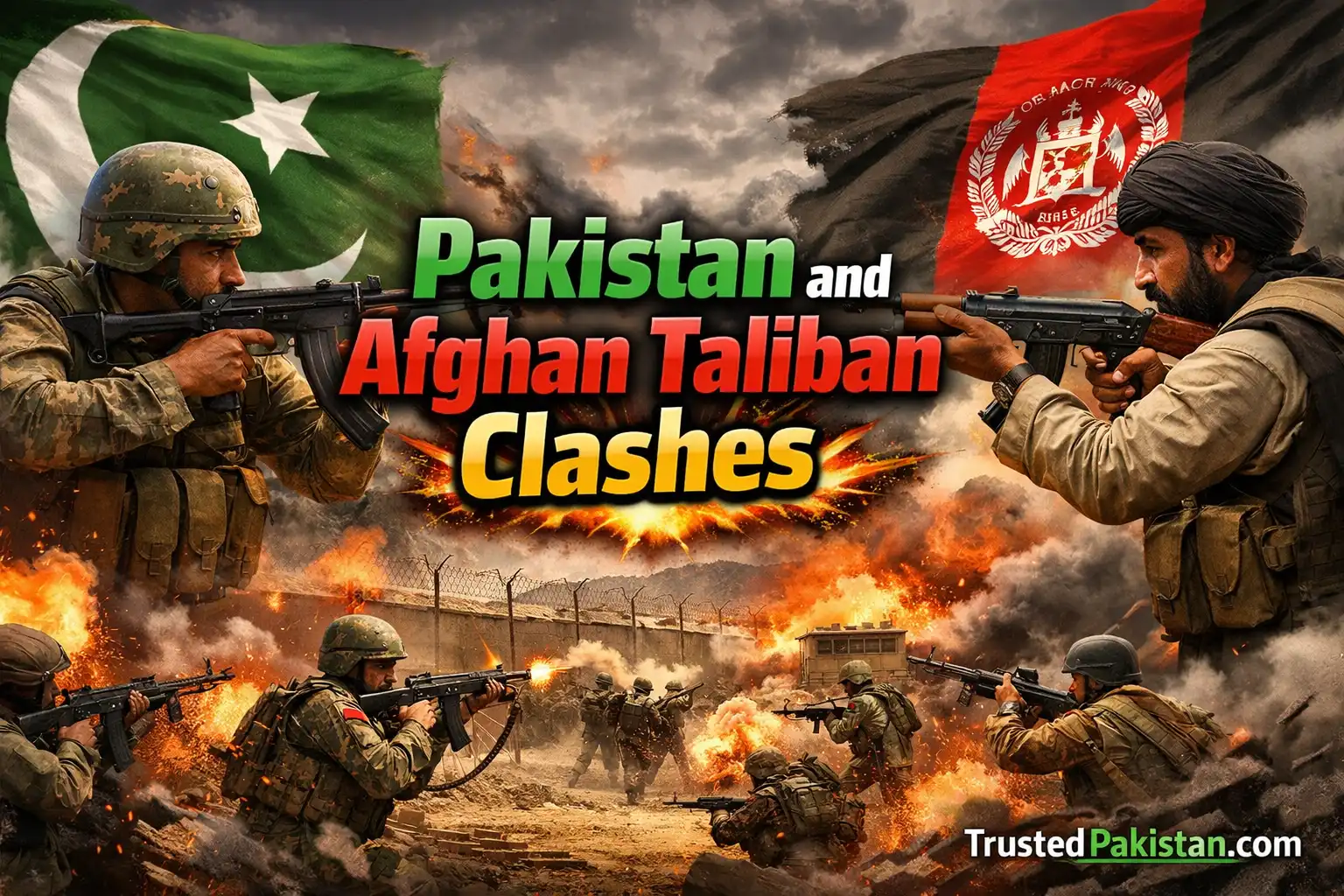
Pakistan and Afghan Taliban Clashes
Pakistan and Afghan Taliban Clashes have intensified in recent weeks, with both sides making serious claims about airstrikes, destroyed military equipment, and targeted border positions. While official confirmations remain limited, reports from security sources and regional observers suggest a rise in cross-border tensions that could significantly impact regional stability.
The situation remains fluid, and independent verification of several claims is still pending. However, available information helps build a clearer picture of what is happening along the Pakistan-Afghanistan border.
1. Background of Pakistan and Afghan Taliban Clashes
Pakistan and Afghan Taliban Clashes are not a new phenomenon. Tensions have existed for years due to disagreements over border management, militant safe havens, and the disputed Durand Line.
Since the Taliban regained control of Afghanistan in 2021, Islamabad and Kabul have repeatedly accused each other of failing to control cross-border militant activity. Pakistan claims that armed groups operating from Afghan territory have launched attacks inside Pakistan. The Afghan Taliban, in contrast, often deny these allegations and accuse Pakistan of violating Afghan sovereignty.
These longstanding disputes form the foundation of the current escalation.
2. Claims of Airstrikes
One of the most serious developments in the recent Pakistan and Afghan Taliban Clashes involves claims of airstrikes.
Pakistani security sources have reportedly conducted targeted operations near border regions, aiming at militant hideouts. Afghan Taliban officials, however, have alleged that Pakistani aircraft crossed into Afghan territory and struck multiple locations.
While Islamabad has framed its actions as counterterrorism measures, Kabul has described them as acts of aggression. Independent confirmation remains limited, but satellite imagery and local testimonies suggest that explosions were heard in several border districts.
3. Allegations of Destroyed Tanks and Military Posts
Another major element in Pakistan and Afghan Taliban Clashes involves claims about destroyed tanks and damaged border posts.
Afghan Taliban sources claim that Pakistani military vehicles and checkpoints were targeted during retaliatory exchanges. Meanwhile, Pakistani officials assert that militant positions and supply routes were dismantled during defensive operations.
Both sides have circulated images and videos on social media to support their narratives. However, digital verification experts warn that some footage may be outdated or misattributed.
What remains clear is that cross-border firing has intensified, and both sides are reinforcing positions along sensitive sectors.
4. Border Security and Strategic Locations
The Pakistan-Afghanistan border stretches over 2,600 kilometers and includes mountainous terrain, making surveillance and control extremely difficult.
Pakistan has fenced large portions of the border in recent years, arguing that it is necessary to prevent militant infiltration. The Afghan Taliban have repeatedly objected to fencing in disputed areas.
Pakistan and Afghan Taliban Clashes frequently occur near strategic crossing points, including Torkham and Spin Boldak. These crossings are vital for trade and humanitarian supplies. Any prolonged disruption could severely affect economic activity on both sides.
For additional background, see our internal analysis on regional security trends: /south-asia-border-security-overview.
5. Civilian Impact and Displacement
Pakistan and Afghan Taliban Clashes are not limited to military consequences. Civilians living near border districts often face the brunt of escalating violence.


Residents in affected regions have reported temporary displacement, school closures, and restricted movement. Local markets have also experienced interruptions due to security concerns.
Human rights observers stress that cross-border military actions risk harming non-combatants, particularly in densely populated villages close to the frontier.
Without a coordinated de-escalation strategy, humanitarian concerns could deepen.
6. Diplomatic Responses
Diplomatic channels between Islamabad and Kabul remain open, but tensions are visible.
Pakistan has summoned Afghan diplomats to protest alleged cross-border attacks. Afghan officials have similarly lodged complaints over what they describe as violations of territorial sovereignty.
Public statements from both governments suggest a desire to avoid full-scale confrontation. However, strong rhetoric in domestic media on both sides has made compromise politically sensitive.
Pakistan and Afghan Taliban Clashes thus sit at the intersection of security policy and domestic political messaging.
7. Regional Security Implications
The broader implications of Pakistan and Afghan Taliban Clashes extend beyond bilateral tensions.
Neighboring countries and global powers are closely monitoring developments. Instability along the border could:
- Increase militant recruitment opportunities
- Disrupt regional trade corridors
- Affect China-Pakistan Economic Corridor projects
- Trigger refugee movements
Security analysts warn that miscalculation remains a serious risk. Limited engagements can quickly escalate if communication channels fail.
Given Afghanistan’s fragile economic condition and Pakistan’s internal security challenges, sustained confrontation would strain both governments.
8. What Could Happen Next
Pakistan and Afghan Taliban Clashes may follow one of several possible trajectories:
- Controlled De-escalation: Quiet diplomatic engagement reduces tensions.
- Intermittent Skirmishes: Sporadic clashes continue without major escalation.
- Wider Confrontation: A significant incident triggers broader military action.
Most experts believe both sides prefer containment rather than escalation. However, border disputes, militant sanctuaries, and mutual distrust remain unresolved core issues.
Confidence-building measures, improved intelligence coordination, and clearer communication channels could reduce the likelihood of future flare-ups.
Emerging Debate | The Future of Border Governance
Beyond the immediate Pakistan and Afghan Taliban Clashes, a larger question is emerging about long-term border governance.
Should there be a formal bilateral security framework?
Can joint border monitoring mechanisms work under current political realities?
Is international mediation necessary, or would it complicate sovereignty concerns?
The durability of peace along the frontier may depend not just on military restraint but on structural agreements addressing trade, security cooperation, and political recognition.
As the region watches closely, Pakistan and Afghan Taliban Clashes highlight the fragile balance between counterterrorism strategy and cross-border diplomacy. The coming months will reveal whether escalation defines the relationship—or whether strategic recalibration prevails.
